The Subaru check engine light blinking cruise control pattern on your dashboard is your car's loudest stop-now signal. It's not a glitch, and it's not something you book for next Tuesday. A blinking check engine light means the engine is actively misfiring right now, cylinder by cylinder, and the flashing cruise light is a companion warning, not a second problem.
Subaru designed it that way on purpose.
What makes this urgent is the catalytic converter sitting downstream of that misfire. Under U.S. EPA emissions warranty rules, that converter is covered for 8 years or 80,000 miles federally, but only when the failure wasn't caused by neglect.
Unburned fuel from a sustained misfire can melt the converter substrate in minutes, not weeks. Manufacturer service data lists the misfire codes as P0300 through P0304 for a reason. Here's what each light is actually telling you.
Quick Answer
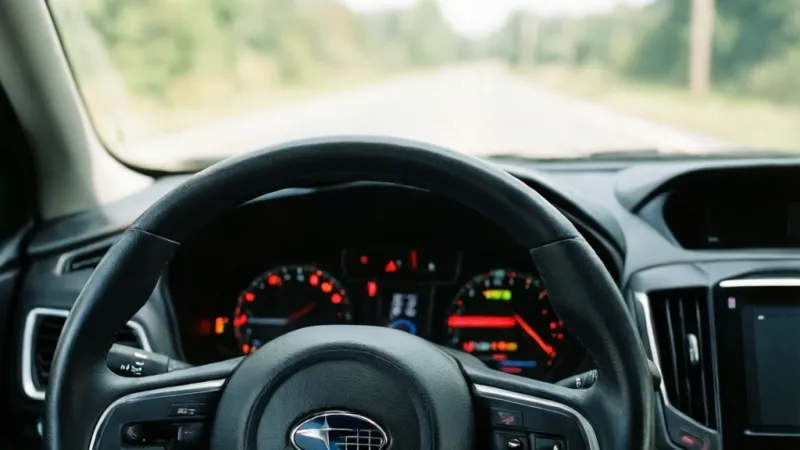
A Subaru check engine light blinking cruise control warning means an active engine misfire. Stop driving as soon as it's safe to pull over. The flashing cruise light is just a companion warning.
Subaru cuts cruise and stability control when a fault sets. Ignoring it can destroy the catalytic converter in minutes.
Why a Blinking Check Engine Light on a Subaru Is a Stop-Driving Signal
A blinking check engine light is the automotive equivalent of a fire alarm. It's not a reminder. It's an active, ongoing failure, and the car is telling you it can no longer protect itself.
On a Subaru, that light flashes when the Engine Control Module (ECM) detects a misfire severe enough to threaten the catalytic converter. The ECM counts misfires in real time. When the count crosses a threshold inside a set window of engine cycles, it stops storing a code quietly and starts flashing the light.
Here's the distinction that matters. A solid check engine light means a fault was logged. The ECM stored it, captured a freeze frame, and went back to running the engine normally.
You have time. A blinking light means the fault is happening right now, cycle after cycle, and the ECM has run out of ways to compensate.
Subaru's own owner's manuals are blunt about this. Manual language across Outback, Forester, Crosstrek, Impreza, Legacy, Ascent, and WRX models tells you to reduce speed, avoid hard acceleration, and get to a safe location. Some model years go further and tell you to stop driving entirely.
What the ECM is actually doing when the light blinks
When misfires cross the threshold, the ECM enters a protective mode. It pulls ignition timing. It cuts fuel to the misfiring cylinder.
On some models it shuts the cylinder down completely to keep raw fuel out of the exhaust.
You'll feel it. The engine idles rough. Power drops.
The car may shake at stoplights or surge under light throttle. That's not a side effect. That's the point.
The ECM would rather run badly than melt your converter.
If/then: the stop-driving decision
- If the light is blinking and the engine is running rough, pull over now and shut it off. Don't idle.
- If the light is blinking but the engine feels normal, you still shouldn't drive far. Misfires can hide at low load and bite hard under throttle.
- If the light is solid, you can usually drive to a shop. Book it soon, but you're not in an emergency.
- If the light blinks, then goes solid, the active misfire has paused. The stored code will still show what happened.
The one narrow exception
There's a rare case where a blinking CEL on a Subaru isn't a misfire. A handful of early-2000s models flashed the light during a specific EVAP test cycle. That's model-specific and unusual.
On anything from the last 15 years, blinking means misfire. Treat it that way.
Blinking vs. Solid Check Engine Light: Two Very Different Emergencies
The two light states look almost identical on the dash. They mean completely different things. Mixing them up is how people turn a $150 ignition coil job into a $2,500 catalytic converter replacement.
Think of it like this. A solid light is a message. A blinking light is an alarm.
Solid check engine light: drive and schedule
A steady CEL means the ECM has logged a fault and stored a code. The engine is running in its normal control strategy. You can drive it.
You can finish your errand. You can book a shop visit for later in the week.
Common causes of a solid CEL on a Subaru include a loose gas cap, a failing oxygen sensor, an EVAP leak, or a stored misfire that has since stopped. None of these are emergencies.
Blinking check engine light: stop and diagnose
A blinking CEL means the misfire is active. The ECM is firing the light in real time to match the misfire events. You need to stop.
The urgency isn't about the engine blowing up tomorrow. It's about the converter melting today. A hot converter from highway driving is the worst case.
A cold one buys you a few more minutes. Neither gives you a free pass to drive 50 miles home.
| Light Behavior | What It Means | What To Do |
|---|---|---|
| Solid CEL | Stored fault, ECM running normally | Drive to a shop soon |
| Blinking CEL | Active misfire, converter at risk | Pull over, shut off the engine |
| Solid CEL plus flashing cruise | Stored fault, cruise disabled | Schedule a diagnosis |
| Blinking CEL plus flashing cruise | Active misfire, cruise and VDC off | Stop driving now |
What about the VDC and EyeSight lights?
On many Subaru models, the Vehicle Dynamics Control (VDC) light and an EyeSight warning join the party. Don't read that as three separate failures. The ECM broadcasts one fault across multiple systems.
Fix the misfire and the rest go dark on their own.
Why Your Subaru's Cruise Control Light Flashes (And Why It's Not the Real Problem)
The flashing cruise light is the part that confuses most Subaru owners. It looks like a second problem. It isn't.
Subaru ties cruise control, Vehicle Dynamics Control, and on newer models EyeSight, into the same fault-handling logic as the engine. When the ECM logs a fault that affects drivability, it tells the rest of the car to stand down. Cruise goes first.
VDC usually follows. EyeSight shuts off with a chime and a message on the multi-function display.
The result is a dashboard lit up like a Christmas tree. Owners see the cruise light, the CEL, maybe the VDC light, and an EyeSight warning, and assume the car is falling apart. It's one fault, broadcast across several systems.
The companion-light design Subaru built in on purpose
Subaru doesn't hide faults. It amplifies them. A flashing cruise light is a louder alarm than a steady CEL, and Subaru uses it exactly that way.
The idea is to get your attention before the damage gets expensive.
This design choice is also why so many owners waste time. They search for "cruise control problem," buy a brake light switch, and never touch the misfire.
When a flashing cruise light really is a cruise system fault
Sometimes cruise fails on its own. A faulty brake light switch, a worn clock spring in the steering wheel, or a wheel speed sensor issue can disable cruise without setting a misfire code.
Here's how to tell the difference:
- If the CEL is on too, the cruise light is almost certainly a companion warning.
- If the CEL is off and only the cruise light flashes, you're looking at a cruise or VDC fault.
- If the cruise light is solid, not flashing, that's usually just cruise disabled, not a fault.
Don't chase the cruise light
Fix the misfire, clear the codes, and the cruise light goes out on its own. Nine times out of ten, that's the whole story. Chasing the cruise light first is how people spend $400 on parts that were never the problem.
What's Happening Inside the Engine: Active Misfire and Catalytic Converter Damage
A misfire is simple to describe. The air-fuel mixture in a cylinder doesn't ignite properly. It could be no spark, weak spark, a wrong fuel ratio, low compression, or a mechanical problem like a valve issue.
What's not simple is what happens to the unburned fuel.
How raw fuel melts a converter substrate
When a cylinder misfires, the fuel it was given doesn't burn. It gets pushed out the exhaust valve as liquid or vapor. It travels down the exhaust pipe and hits the catalytic converter.
A converter works by burning off leftover hydrocarbons at around 1,400 to 1,600 degrees Fahrenheit. That's normal. But raw, unburned fuel is different.
It ignites inside the converter and pushes temperatures past 2,000 degrees.
The substrate inside the converter is a ceramic honeycomb coated in platinum, palladium, and rhodium. At those temperatures it starts to melt. It sags.
It plugs. Once that happens, the converter is done, and no amount of cleaning brings it back.
Why limp mode kicks in and pulls your power
Subaru's ECM tries to prevent this. When misfires hit the threshold, it enters what the industry calls limp mode, or reduced power mode.
What it does:
- Retards ignition timing
- Cuts fuel to the misfiring cylinder
- Disables the cylinder entirely on some models
- Limits engine RPM and throttle response
You'll feel sluggish acceleration and a rough idle. That's the ECM trading performance for converter survival.
How fast does damage happen?
This is the part that scares technicians. Damage can start inside a minute of sustained misfire. A converter already hot from highway driving is more vulnerable than a cold one.
Real-world repair data suggests the following:
- 5 minutes of hard misfire can be enough to trigger a P0420 code
- 20 to 30 minutes can permanently melt the substrate
- A tow is always cheaper than a new converter
That's why "drive it home and book an appointment" is dangerous advice when the light is blinking. Check your VIN against open campaigns at NHTSA before you assume the fault is unrelated to a recall.
The Codes Behind the Lights: P0300 to P0304, P0420, P0171, and P0700
The light is a symptom. The codes are the story. When you scan a Subaru with a blinking CEL, you'll usually pull one of a handful of codes.
| Code | Meaning | Urgency |
|---|---|---|
| P0300 | Random or multiple cylinder misfire | High |
| P0301 | Cylinder 1 misfire | High |
| P0302 | Cylinder 2 misfire | High |
| P0303 | Cylinder 3 misfire | High |
| P0304 | Cylinder 4 misfire | High |
| P0420 | Catalyst system efficiency below threshold | Medium |
| P0171 | System too lean (bank 1) | Medium to High |
| P0700 | Transmission control system fault | Medium to High |
Misfire codes vs. consequence codes
P030x codes are cause codes. They tell you something is wrong with combustion right now.
P0420 is a consequence code. It usually means the converter already took damage from a misfire that went unfixed. Seeing a P0420 with no active misfire doesn't mean you got lucky.
It means the damage already happened.
P0171 is a fuel trim code. A vacuum leak, a dirty mass air flow sensor, or a failing intake gasket can push the mixture lean enough to cause misfires. Treat it as a cause code, not a symptom.
When P0700 and a flashing cruise light point at the CVT instead
On Subaru models with a Lineartronic CVT, a P0700 can set alongside a flashing cruise light with no engine misfire at all. The CVT has its own control module, and when it logs a fault, it tells the ECM to disable cruise and VDC just like an engine fault would.
If your scan pulls P0700 with no P030x codes, the misfire theory is off the table. You're looking at a transmission control issue. That changes the diagnostic path entirely, and it usually means a dealer or a Subaru specialist, not a driveway repair.
Reading freeze frame data
The freeze frame is a snapshot of engine conditions at the exact moment the fault set. Engine RPM, load, coolant temperature, vehicle speed. It's one of the most useful tools you have, because it tells you whether the misfire happens at idle, under load, or on cold start.
Cold-start misfires point at ignition or fuel delivery. Load misfires point at coils or compression. Idle misfires point at vacuum leaks or injectors.
The freeze frame narrows the field before you turn a single bolt.
One last thing. The EPA publishes emissions warranty terms at EPA.gov, and those terms matter here. If a misfire killed your converter, the repair might be covered, but only if the misfire itself was addressed.
Clearing the code and driving on is the fastest way to void that coverage.
Subaru-Specific Causes: Head Gaskets, Oil-Fouled Plug Wells, AVCS, and Carbon Buildup
Generic misfire advice will only get you so far on a Subaru. The boxer layout and the specific failure patterns these engines are known for mean some causes show up far more often than others.
Here's what our research into Subaru service data and technician reports turns up as the most common culprits.
EJ25 head gasket failure and coolant intrusion
The EJ25 is the engine that built Subaru's head gasket reputation, and it earned it. On these engines, the head gasket can fail between the coolant jacket and the combustion chamber. Coolant seeps in, dilutes the mixture, and you get a misfire that comes and goes.
What to look for:
- Coolant level dropping with no visible leak
- White sweet-smelling exhaust smoke
- Bubbles in the coolant overflow tank while running
- A misfire that's worse on cold start and clears as the engine warms
A cooling system pressure test and a combustion gas test on the coolant will confirm it. If the head gasket is the cause, no ignition part will fix it. This is a $1,500 to $3,000 job depending on the shop and whether the heads need machining.
Valve cover tube seal leaks that mimic dead coils
This one catches people every time. The spark plug tubes on a Subaru boxer sit inside the valve cover, sealed by a tube seal at the top. When that seal hardens and leaks, oil pools around the spark plug boot.
Oil breaks down the boot's insulation. You get a misfire that looks exactly like a bad coil. Owners replace the coil, the misfire goes away for a week, then it comes back because the oil is still there.
Check the plug wells before you replace any coil. If the boot is oily or the plug is soaked, replace the tube seals and the valve cover gaskets at the same time. The parts are cheap.
The labor overlaps almost entirely with the coil job.
Direct-injection carbon on FA and FB engines
The FA20DIT, FA24, and FB-series engines use direct injection. Fuel is sprayed straight into the cylinder, not over the intake valves. That means nothing washes the valves clean.
Over 60,000 to 100,000 miles, carbon builds up on the intake valve stems and heads. Airflow gets restricted, the mixture goes wrong, and you get misfires, rough idle, and lean codes like P0171.
Signs of carbon buildup:
- Rough idle that smooths out above 1,500 RPM
- Misfires on cold start that fade once warm
- P0300 or individual P030x codes with no ignition fault
- Hesitation under light throttle
Walnut blasting is the standard fix. A shop uses crushed walnut shells to blast the carbon off the valves. Cost runs $400 to $900 depending on the region and whether it's a four-cylinder or six.
AVCS oil control valve screens
Subaru's Active Valve Control System (AVCS) uses oil pressure to vary cam timing. The oil control valves have fine mesh screens that can clog with sludge from old or low-quality oil.
When a screen clogs, cam timing goes off. You get misfires, a rough idle, and codes like P0011 or P0021 alongside the P030x codes. On turbo models, this can show up as boost issues too.
The fix is usually cleaning or replacing the oil control valve. It's not expensive, but it only works if you also fix the oil maintenance habit that caused the sludge. Fresh oil at proper intervals is the prevention.
Other causes worth ruling out
Not everything is Subaru-specific. The usual suspects still apply.
- Vacuum and intake manifold gasket leaks cause lean misfires. A smoke test finds them fast.
- Dirty or failing MAF sensor skews fuel trim. Clean it with MAF-specific spray, never brake cleaner.
- Low fuel pressure from a failing pump causes lean misfires under load. Check the NHTSA recall database for your VIN.
- Worn spark plugs past 60,000 miles are the simplest cause and the easiest to rule out.
The 10-Minute Roadside Decision: Drive, Tow, or Shut It Down
You're on the side of the road with a blinking CEL and a flashing cruise light. Here's how to make the call.
The answer depends on three things: how the engine is running, where you are, and what you have with you. Work through it in order.
Step 1: Is the engine running rough?
Shut the car off and restart it once. If the light goes solid or stays off, the active misfire has paused. You may be able to limp a short distance to a safe spot.
If the light blinks again within 30 seconds of restart, the misfire is active and consistent. That's a tow.
Step 2: How far are you from safety?
If you're on a highway shoulder, in a tunnel, or on a bridge, get to safety first. A blinking CEL on a highway is a tow situation almost every time. The converter is hottest at highway speed, and the damage clock is running.
If you're in a parking lot or on a quiet side street, you have more options. A short, gentle drive to a nearby shop is sometimes reasonable. Emphasis on short and gentle.
Step 3: Do you have a scan tool?
A basic Bluetooth OBD-II dongle costs $20 to $40. If you have one, plug it in and read the codes before you decide. A P0301 with a rough idle is a tow.
A P0455 EVAP code with a solid light is not.
The if/then decision tree
- If the CEL is blinking and the engine is shaking, shut it down and call for a tow.
- If the CEL is blinking but the engine idles smooth, drive gently to the nearest safe parking spot, then decide.
- If the CEL went solid after restart and the engine runs fine, drive to a shop within a few miles.
- If you have no scan tool and no idea what's wrong, tow it. The cost of a tow is $75 to $150. The cost of a melted converter is $1,200 to $2,500.
- If you're on a highway and the light is blinking, tow it. No exceptions.
What to tell the tow driver
Tell them the check engine light is blinking and you suspect an active misfire. Ask them to flatbed it if possible. A flatbed avoids any chance of the drive wheels turning the engine during the tow.
What not to do
Don't clear the codes and keep driving. Don't assume it will "work itself out." Don't run the engine at idle to "see if it clears." Idling with a misfire is still pumping raw fuel into the converter, just more slowly.
How to Read Your Own Codes: OBD-II Port Location, Scan Tools, and Freeze Frame Data
Reading your own codes is the single most useful skill you can pick up as a Subaru owner. It takes 10 minutes and a $30 tool.
The OBD-II port is a standardized 16-pin connector. It's usually under the driver's side dash, near the hood release or the fuse panel. On most Subarus from 1996 onward, you'll find it within a foot of the steering column.
Where the port lives on Outback, Forester, Crosstrek, and WRX
The location is consistent across most Subaru models, but there are small differences.
| Model | OBD-II Port Location |
|---|---|
| Outback (2010+) | Under driver's dash, left of steering column |
| Forester (2009+) | Under driver's dash, near hood release |
| Crosstrek | Under driver's dash, left of steering column |
| Impreza | Under driver's dash, near fuse panel |
| Legacy | Under driver's dash, left of steering column |
| WRX / STI | Under driver's dash, left of steering column |
| Ascent | Under driver's dash, left of steering column |
If you can't find it, look for a trapezoid-shaped plastic connector with visible metal pins. It's usually facing down toward the pedals.
Choosing a scan tool
You don't need a $2,000 professional unit for this job. Here's what the tiers actually get you.
| Tool Type | Cost | What It Does |
|---|---|---|
| Basic code reader | $20 to $50 | Reads and clears codes only |
| Bluetooth OBD-II dongle | $20 to $40 | Reads codes, live data, freeze frame via phone app |
| Mid-tier handheld | $100 to $250 | Live data, Mode $06, some bidirectional controls |
| Subaru Select Monitor (SSM4) | Dealer-only | Full manufacturer diagnostics and reprogramming |
For most owners, a Bluetooth dongle paired with a free or low-cost app is plenty. You'll get codes, freeze frame, and live misfire counters.
Freeze frame and live misfire counters explained
Freeze frame is a snapshot of engine conditions at the moment the code set. It shows RPM, load, coolant temperature, vehicle speed, and fuel trim at that instant.
Live misfire counters are even better. They show how many misfires each cylinder has logged since the engine started. A cylinder with 500 misfires while the others sit at zero is your problem cylinder.
Watch the counters at idle, then at 2,500 RPM, then under load. The pattern tells you where to look:
- Misfires only at idle point at vacuum leaks or injectors
- Misfires only under load point at coils or compression
- Misfires on cold start that clear when warm point at valve seals or carbon
- Misfires that move with a swapped coil point at the coil
Mode $06 data
Mode $06 is the raw test data the ECM uses to make its own decisions. It shows misfire counts per cylinder, catalyst efficiency values, and oxygen sensor response. It's more technical than most owners need, but it's the data a technician uses to confirm a diagnosis before replacing parts.
Step-by-Step Diagnosis: From Coil Swap Tests to Compression Checks
Once you know the misfire is real, the diagnosis is a process of elimination. Work from the cheapest, easiest checks to the expensive ones.
Here's the order that saves the most time and money.
Step 1: Pull the codes and freeze frame
Read the codes. Note the freeze frame. Check which cylinders are misfiring.
If you see P0301, that's cylinder 1. If you see P0300, it's random or multiple cylinders.
Step 2: Visual inspection
Look for the obvious stuff first. Check for disconnected vacuum lines, cracked intake boots, and a loose oil filler cap. On a Subaru, the oil filler cap being loose can set a lean code on some models.
Check the plug wells for oil. Pull the coil boots and look for oil, corrosion, or burnt residue.
Step 3: Spark plug inspection
Pull the plugs. Read their condition.
- Oil-fouled plug: tube seal leak or valve guide wear
- Fuel-fouled black plug: rich condition or weak spark
- White or blistered plug: lean condition or overheating
- Worn electrode: replace them all, they're due
If the plugs are past 60,000 miles, replace them regardless of condition. Use the factory-specified iridium plugs.
Step 4: Coil swap test
Swap the coil from the misfiring cylinder with one from a known-good cylinder. Clear the codes. Drive the car or run it until the misfire sets again.
If the misfire follows the coil, the coil is bad. If the misfire stays on the same cylinder, the coil was fine and the problem is elsewhere.
Step 5: Fuel and injector testing
Check fuel pressure at the rail. Low pressure under load points at a failing pump or clogged filter. Check the injector resistance with a multimeter.
A failed injector is common on high-mileage Subarus.
Step 6: Compression test
A compression test tells you whether the cylinder can hold pressure. Disconnect the fuel pump and ignition. Crank the engine and read each cylinder.
Spec for most Subaru four-cylinders is 150 to 200 PSI, with no more than 10 percent variance between cylinders. A low cylinder points at rings, valves, or a head gasket.
Step 7: Leak-down test
A leak-down test pinpoints where the compression is going. You pressurize the cylinder and listen for where air escapes.
- Air out the intake: intake valve leak
- Air out the exhaust: exhaust valve leak
- Air out the dipstick: ring or piston damage
- Bubbles in the coolant: head gasket or cracked head
Step 8: Cooling system pressure test
If you suspect a head gasket, pressurize the cooling system and watch for pressure loss or coolant in the cylinders. A combustion gas test on the coolant confirms it.
The order matters
Start with the free checks. Plugs, coils, vacuum lines, and visual inspection catch most misfires. Compression and leak-down tests are for when the simple stuff comes up clean.
Skipping ahead to the expensive tests wastes time and money.
What Each Repair Actually Costs (And What Your Emissions Warranty Covers)
Costs vary by region, shop type, and whether you use OEM or aftermarket parts. Here's what our research into current shop rates and parts pricing turns up as of 2026.
| Repair | Parts | Labor | Total Range |
|---|---|---|---|
| Spark plugs (four-cylinder) | $60 to $120 | $150 to $300 | $210 to $420 |
| Ignition coil (one) | $60 to $150 | $50 to $150 | $110 to $300 |
| Valve cover tube seals | $30 to $80 | $300 to $600 | $330 to $680 |
| Fuel injector (one) | $80 to $200 | $150 to $400 | $230 to $600 |
| Walnut blasting (direct injection) | N/A | $400 to $900 | $400 to $900 |
| Head gasket (EJ25) | $300 to $600 | $1,200 to $2,400 | $1,500 to $3,000 |
| Catalytic converter (OEM) | $1,200 to $2,500 | $150 to $400 | $1,350 to $2,900 |
| Catalytic converter (aftermarket) | $300 to $900 | $150 to $400 | $450 to $1,300 |
The emissions warranty is your best friend
Federal law requires manufacturers to cover emissions control components for specific periods. The EPA sets the minimums, and Subaru follows them.
- Catalytic converter and ECM: 8 years or 80,000 miles, whichever comes first
- Other emissions components: 2 years or 24,000 miles
- California and Section 177 states: 7 years or 70,000 miles for the converter and ECM
If your misfire killed the converter and you're inside the warranty window, the repair may be covered. But there's a catch. The warranty covers defects in materials or workmanship.
It does not cover damage caused by neglect.
That means if you drove for a month with a blinking CEL and never fixed the misfire, Subaru can deny the converter claim. Fix the misfire first, then file the converter claim.
Dealer vs. independent Subaru specialist vs. DIY
Each option has a place.
- Dealer: Best for warranty work, software updates, and complex diagnostics. Highest labor rate, typically $150 to $200 per hour.
- Independent Subaru specialist: Best for out-of-warranty repairs. Often 20 to 40 percent cheaper than the dealer, with the same diagnostic tools.
- DIY: Best for plugs, coils, and simple sensor replacements. Not worth it for head gaskets or converter swaps unless you have a lift and experience.
What to ask before you approve a repair
Ask for the diagnostic findings in writing. Ask what tests confirmed the diagnosis. Ask whether the repair is covered under warranty.
If a shop wants to replace a converter without first fixing the misfire that killed it, walk away. The new converter will fail the same way in a few thousand miles.
Mistakes That Turn a $150 Fix Into a $3,000 Bill
The difference between a cheap repair and an expensive one usually comes down to a handful of avoidable mistakes. Our research into repair shop data and owner forums shows the same patterns repeating over and over.
Here are the ones that cost the most money.
Clearing codes and calling it fixed
This is the number one mistake. You scan the codes, you hit "clear," the light goes off, and you feel like a hero. Two days later, the light comes back and now you've reset the readiness monitors.
Those monitors need to complete their test cycles before an emissions test can pass. Clearing codes resets them all. You now have to drive 50 to 100 miles of mixed conditions to get them ready again.
Worse, you've erased the freeze frame data that would have told a technician exactly when the misfire happened. You threw away the evidence.
Chasing the cruise light instead of the misfire
The flashing cruise light is the loudest thing on the dash. It's also not the problem. Owners buy brake light switches, clock springs, and cruise control modules trying to fix it.
None of that works, because the cruise system isn't broken. The ECM told it to stand down. Fix the misfire, and the cruise light goes out on its own.
Assuming a loose gas cap can cause a blinking CEL
A loose gas cap sets an EVAP code like P0455 or P0457. That's a solid check engine light. A loose gas cap cannot cause a blinking CEL, because it can't cause a misfire.
If you tighten the cap, clear the code, and the light comes back blinking, the cap was never the issue. You just wasted two days.
Replacing parts without testing
This is the parts-cannon approach. Replace the coil, then the plug, then the injector, then the MAF sensor, hoping one of them fixes it. Each part costs money and none of them were confirmed bad.
The right approach is testing, not swapping. Swap-test the coil to see if the misfire follows it. Check compression before you buy anything.
Confirm the diagnosis before you spend a dollar.
Ignoring the oil in the plug well
You pull the coil, see oil on the boot, wipe it off, and install a new coil. The misfire goes away for a week. Then it's back.
The oil is still leaking from the tube seal. It will foul the new coil too. Replace the tube seals and valve cover gaskets at the same time as the coil, or you'll be back under the hood in a month.
Driving on a misfire to "see if it clears"
Misfires don't clear on their own when the cause is mechanical or electrical. They clear when the ECM shuts the cylinder down, which is not the same thing.
Every mile you drive with an active misfire pumps raw fuel into the converter. The damage is cumulative and irreversible.
Using the wrong spark plugs
Subaru specifies iridium plugs for a reason. They last longer and hold the correct gap under heat. Cheap copper plugs work, but they wear out fast and can cause misfires on their own.
Use the factory-specified plug. Check the gap before you install it, even on pre-gapped plugs. A dropped plug can close the gap and cause the exact misfire you're trying to fix.
The cost of each mistake
| Mistake | Typical Extra Cost |
|---|---|
| Clearing codes without repair | $100 to $175 diagnostic fee, repeat visit |
| Chasing the cruise light | $200 to $400 in unnecessary parts |
| Parts-cannon approach | $300 to $800 in unneeded parts |
| Ignoring tube seal leak | $110 to $300 for a second coil |
| Driving on a misfire | $1,200 to $2,500 for a new converter |
Model-by-Model Notes: Outback, Forester, Crosstrek, WRX, Ascent, and Legacy
Subaru's boxer engines share a lot of DNA, but each model has its own failure patterns. Knowing what to expect for your specific car saves time and money.
Here's what our research shows for the most common models on the road as of 2026.
Outback
The Outback has run the FB25 four-cylinder and the EZ36 six-cylinder in recent generations. The FB25 is a solid engine, but early versions had oil consumption issues that led to a class action settlement.
Misfire causes on the Outback tend to be ignition-related first. Coils, plugs, and tube seals are the usual suspects. On higher-mileage FB25s, carbon buildup on the intake valves causes cold-start misfires.
The CVT in the Outback can set a P0700 with a flashing cruise light and no engine misfire at all. If that's your code set, the transmission is the story, not the engine.
Forester
The Forester is where the EJ25 head gasket reputation lives. The 2009 to 2013 Forester XT and the non-turbo models from that era are the ones most likely to develop head gasket leaks.
Later Foresters moved to the FB25 and FB20, which are less prone to head gasket failure but more prone to oil consumption and carbon buildup.
If you own a Forester with a blinking CEL and a coolant level that keeps dropping, get a combustion gas test done before you spend money on ignition parts.
Crosstrek
The Crosstrek runs the FB20, which moved to direct injection in 2018. Direct injection means carbon buildup on the intake valves over time.
Misfires on a high-mileage Crosstrek often trace back to carbon. The symptoms are a rough idle that smooths out at speed and misfire codes with no ignition fault.
The fix is walnut blasting. It's not cheap, but it's the right repair. Replacing coils and plugs won't touch carbon buildup.
WRX and STI
The WRX and STI are performance cars, and they get driven like it. That changes the failure patterns.
The EJ257 in the STI is known for ringland failure, which causes low compression and misfires on specific cylinders. It's a serious repair that usually means a short block replacement.
The FA20DIT in the 2015 and newer WRX is prone to carbon buildup and, on some tuned cars, lean conditions that cause misfires under boost. If you've modified the tune, the misfire may be a tuning issue, not a hardware failure.
Ascent
The Ascent runs the FA24 and a CVT. It's a newer platform with fewer documented misfire patterns, but the direct injection means carbon buildup is a long-term concern.
The most common cause of a flashing cruise light on an Ascent is a CVT fault code P0700 with no engine misfire. If you see that combination, don't start replacing ignition parts.
Legacy
The Legacy has run the EJ25, the FB25, and the EZ36 six-cylinder over the years. The failure patterns match the engine, not the body.
If you own a Legacy with the EZ36, misfires are less common, but when they happen, they're usually ignition or fuel delivery related. The six-cylinder is a tight engine bay, so labor costs run higher.
Model-specific quick reference
| Model | Most Common Misfire Cause | Watch For |
|---|---|---|
| Outback | Ignition, carbon buildup | CVT P0700 with flashing cruise |
| Forester | Head gasket (EJ25), carbon (FB) | Coolant loss, white exhaust |
| Crosstrek | Carbon buildup | Rough idle that smooths at speed |
| WRX / STI | Ringland failure (EJ257), carbon (FA20) | Low compression on one cylinder |
| Ascent | CVT faults | P0700 with no misfire |
| Legacy | Ignition, fuel delivery | Higher labor costs on EZ36 |
When to Stop DIYing and Hand It to a Subaru Specialist
DIY repairs save money on simple jobs. They cost money on complex ones. Knowing where the line is keeps you out of trouble.
Here's how to decide whether a job is worth doing yourself.
Jobs that are reasonable for a confident DIYer
These are the repairs that need basic tools and don't require lifting the engine or opening the block.
- Spark plug replacement
- Ignition coil replacement
- Valve cover tube seal and gasket replacement
- MAF sensor cleaning or replacement
- Air filter replacement
- Basic OBD-II code reading and clearing
These jobs take a few hours, need a socket set and torque wrench, and don't put the engine at risk. If you have the tools and the patience, they're worth doing.
Jobs that should go to a shop
These are the repairs that need specialized tools, significant disassembly, or a lift.
- Head gasket replacement
- Compression and leak-down testing
- Walnut blasting for carbon removal
- Catalytic converter replacement
- Fuel injector replacement on direct-injection engines
- Any job that requires dropping the subframe or lifting the engine
The tools alone for these jobs cost more than the repair. The risk of doing them wrong is high, and a mistake can destroy the engine.
Warning signs you're over your head
Stop and call a professional if any of these happen.
- You've replaced parts and the misfire hasn't changed
- You're seeing coolant in the oil or oil in the coolant
- The engine overheats or loses coolant with no visible leak
- You can't get a bolt loose without risking stripping it
- You're not sure which cylinder is misfiring
What to bring to the shop
If you're handing it off, bring your notes. The codes, the freeze frame, what you've already replaced, and what the symptoms are. A good technician uses that information to skip straight to the diagnosis.
Tell them the check engine light was blinking, not just on. That single detail changes how they approach the job.
The DIY risk assessment
| Factor | DIY-Friendly | Hand It Off |
|---|---|---|
| Tools needed | Basic socket set | Specialized or dealer-only |
| Engine disassembly | None | Head, block, or timing |
| Risk of damage | Low | High |
| Time required | Under 3 hours | Full day or more |
| Diagnosis clarity | Code points to one part | Multiple possible causes |
Frequently Asked Questions
Can I drive with a blinking check engine light?
No. A blinking check engine light means an active misfire that can destroy your catalytic converter in minutes. Pull over safely, shut the engine off, and arrange a tow.
Driving even a few miles can turn a $150 repair into a $2,500 one.
Why does my cruise control light flash but the engine feels fine?
The cruise light flashes because the ECM disabled cruise when it logged a fault, not because cruise itself is broken. The engine may feel fine at low load, but the misfire can still be active. Read the codes before assuming it's safe to drive.
Will clearing the code make the light stay off?
No. Clearing the code turns the light off temporarily, but the underlying fault remains. The light will return, usually within a few drive cycles.
Clearing codes also resets emissions readiness monitors, which can cause you to fail an emissions test even after the repair.
Does a blinking check engine light always mean a misfire?
On any Subaru from the last 15 years, yes. A blinking CEL is the ECM's misfire alarm. The only exceptions are a few early-2000s models that flashed during specific EVAP test cycles.
Treat a blinking CEL as a misfire until proven otherwise.
Can cold weather cause a blinking check engine light?
Cold weather can trigger or worsen a misfire, but it doesn't cause one on its own. Cold starts need richer fuel mixtures, which expose weak ignition components. If your Subaru only misfires on cold mornings, the cause is likely a failing coil, worn plugs, or carbon buildup.
Is my catalytic converter covered if a misfire killed it?
Maybe. Federal emissions warranty covers the converter for 8 years or 80,000 miles. California and Section 177 states cover it for 7 years or 70,000 miles.
But the warranty doesn't cover damage from neglect. If you drove on a blinking CEL for weeks, Subaru can deny the claim.
Why does my Subaru flash the cruise light with a P0700 code?
A P0700 code means the transmission control module logged a fault. On Subaru CVT models, that fault disables cruise and VDC just like an engine misfire would. If you see P0700 with no P030x codes, the problem is in the transmission, not the engine.
How much does a diagnostic scan cost?
A basic code scan is free at most auto parts stores. A dealer diagnostic runs $100 to $175. An independent Subaru specialist usually charges $75 to $150.
For anything beyond reading codes, the professional diagnosis is worth the money.
The Bottom Line: Your Decision Guide
A blinking check engine light with a flashing cruise control light on a Subaru is a stop-driving event, not a schedule-it-later event. The light pattern tells you the engine is actively misfiring, and the cruise light is a companion warning, not a separate fault.
Here's the short version of everything above.
If the light is blinking
- Pull over safely and shut the engine off
- Don't idle, don't drive home, don't "see if it clears"
- Arrange a tow to a shop or your driveway
- Read the codes before you spend money on parts
If the light is solid
- You can drive to a shop within a reasonable distance
- Book a diagnosis soon, but it's not an emergency
- Check the gas cap and look for obvious issues first
If the cruise light is flashing too
- It's a companion warning, not a second problem
- Fix the misfire and the cruise light goes out on its own
- If there's no misfire code, check for a P0700 transmission fault
If you're not sure what to do
- Tow it. A $100 tow beats a $2,500 converter every time
- Get the codes read before you authorize any repair
- Ask for the diagnostic findings in writing
The one rule that matters most
Don't drive on a blinking check engine light. Everything else in this guide is secondary to that single decision. The cost of stopping is a tow.
The cost of ignoring it is a converter, and sometimes an engine.