If your Carrier furnace blinking yellow light has you staring at the control board, you're in the right place. That amber flash isn't random. It's the board's way of telling you exactly which fault tripped the furnace, and the code changes everything about what you do next.
Get the count wrong, and you could be replacing parts that were never the problem.
Carrier's service documentation confirms that the amber LED on the integrated furnace control board (IFC) reports faults by counting blinks, and those codes vary by model and board revision. As of 2026, the 58 and 59 series furnaces still use this same basic system with model-specific twists. Here's how to decode what your furnace is actually telling you.
Quick Answer
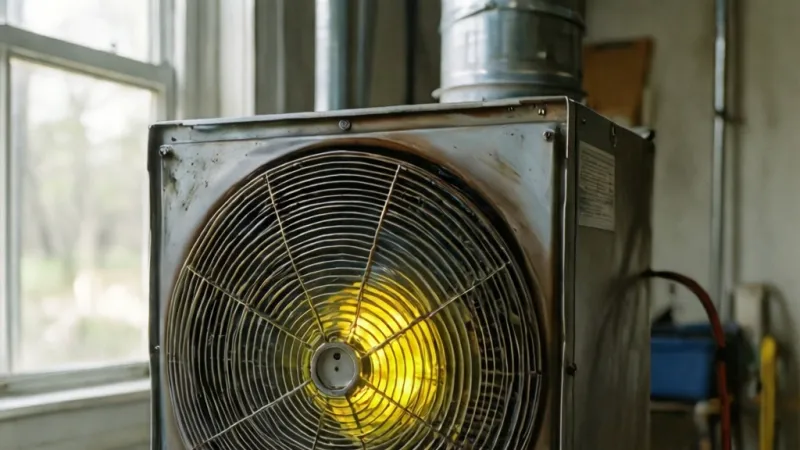
A Carrier furnace blinking yellow light is a fault code from the control board. The number of blinks identifies the specific fault. Common causes include flame sensor issues, pressure switch faults, and limit trips.
Count the blinks, then check your model's code chart. Never reset more than once if you smell gas.
Why Your Carrier Furnace Is Blinking Yellow and What That Light Is Telling You
The amber LED on your furnace is a diagnostic tool, not a simple on/off indicator. It lives on the integrated furnace control board (IFC). That's the main circuit board that runs the ignition sequence, monitors safety switches, and decides whether to allow the burners to fire.
When something in that sequence fails, the board stops the cycle and stores the fault. Then it flashes the code on the amber LED. The number of blinks is the code number.
Carrier has used this system on gas furnaces for decades. The exact code set varies by model, board revision, and furnace series. A 2-blink code on a 58MCA from the 2000s may not mean the same thing as a 2-blink code on a 59MN7 modulating furnace.
That's the single most important thing to understand here. Anyone who tells you "yellow blinking means X" without asking your model number is guessing.
What the light color tells you
Carrier furnaces have used three LED colors over the years, and each one carries different weight.
- Amber or yellow: the standard diagnostic color on most modern Carrier furnaces.
- Red: used on some older Carrier and Bryant models, and on certain ignition control boards.
- Green: usually means "power on" or "normal operation," not a fault.
If your LED is green and blinking, that's often a heartbeat or status indicator, not a fault. If it's amber and blinking, treat it as a fault code until you prove otherwise.
Blinking vs. solid light
A solid amber light usually means the board is powered but not currently flashing a code. Some models use a solid light to mean "standby" or "no call for heat."
A solid light during an active call for heat often means the board has locked out. A blinking light means there's an active or stored fault code you can read.
The board remembers the last fault
Most Carrier IFC boards store the last fault code, even after the fault clears. That's why you might see a blink pattern with the furnace apparently running fine.
Some boards have a recall button you can press to replay the stored code. Others clear the memory after a power cycle. This matters when a technician arrives and wants to see what tripped the furnace in the first place.
If your furnace has been cycling on and off for days, the stored code may be more useful than the current one.
How the Amber Diagnostic LED Works and What Changes the Answer
Where the LED sits on your Carrier furnace
The amber LED sits on the IFC, and the IFC is almost always behind the blower door on the lower half of the furnace cabinet. You'll need to remove the door to see it.
On many Carrier models, there's a small plastic window or a sight glass you can look through without removing anything. If you have one, use it. You'll avoid the door switch issue entirely.
Why the door switch matters
The blower door has a safety switch. When you remove the door, that switch opens and cuts power to the blower and often to the board itself.
Some boards stay powered with the door off. Others go dark. If your LED goes out when you remove the door, look through the sight glass or hold the door switch in with a piece of tape while you watch, with the door still off and clear of moving parts.
Never tape a door switch closed and walk away. That defeats a safety device.
Finding your model and board revision
The model and serial plate is usually on the inside of the blower door, or on the side of the cabinet near the bottom. Take a photo of it before you do anything else.
The model number tells you four things you actually need.
- The series, such as 58 for 80% AFUE or 59 for 90%+ condensing.
- The cabinet size and airflow class.
- The ignition type.
- The board family.
You'll need this number to look up the correct flash code chart. The chart is printed on a sticker inside the door on many models. If it's missing, Carrier's official support site and your model's installation manual are the only reliable sources.
How to count the blinks correctly
This trips up almost everyone the first time.
- Watch the LED for a full minute before counting.
- The pattern repeats. Count one full cycle.
- A short pause, about a quarter second, separates blinks within a code.
- A longer pause, about 1 to 2 seconds, separates codes.
- A very long pause of 3+ seconds means the code is starting over.
On most Carrier furnaces, the code is a single digit from 1 to 9. On a few higher-end models with communicating boards, you may see a two-digit code, with the first digit and second digit separated by a long pause.
If the LED blinks continuously with no pause, that's not a code. That's usually an internal board fault.
What the manual actually says
The flash code chart in your installation manual is the only authority for your specific furnace. Here's a rough guide to how Carrier organizes them.
| Code Family | Typical Meaning |
|---|---|
| 1 to 3 blinks | Ignition sequence faults (pressure switch, inducer) |
| 4 to 5 blinks | Safety switch trips (limit, rollout) |
| 6 to 7 blinks | Flame faults (no flame, lost flame) |
| 8 to 9 blinks | Blower, polarity, or control board faults |
| Continuous | Board fault or lockout condition |
Treat this as a starting point, not a substitute for the manual. The 58MCA, 58MVP, 58CVA, 58STA, 59MN7, and 59TP6 all have different code sets.
Soft lockout vs. hard lockout
This is the difference between "wait an hour" and "call someone."
- Soft lockout: the board stops the cycle and retries after a set delay, usually 1 hour. The LED keeps blinking the fault.
- Hard lockout: the board stops until you cycle power or fix the fault. Sometimes the LED stops blinking entirely.
Soft lockout usually means the fault is intermittent, like a pressure switch that's slow to close. Hard lockout usually means a safety switch is stuck open or a component has failed.
Reading fault memory on newer boards
Newer Carrier communicating furnaces, especially in the Infinity and Performance lines, display the code on the thermostat instead of just the board. That's a huge time-saver.
If you have a communicating thermostat, check the error log in the installer menu. It'll show the last several faults with timestamps.
Reading the Blink Count: What Each Carrier Flash Code Usually Means
The table below reflects the most common mapping across Carrier's 58 and 59 series furnaces. Your exact model may differ by one or two codes, so verify against your manual before you buy any parts.
| Blinks | Common Meaning | Typical Cause |
|---|---|---|
| 1 | No fault stored or system in lockout | Fresh board, recent power cycle, or ignition lockout |
| 2 | Pressure switch stuck open | Blocked vent, inducer issue, condensate clog |
| 3 | Pressure switch stuck closed | Failed switch, stuck diaphragm, wiring short |
| 4 | Limit switch open | Overheating, dirty filter, blocked return air |
| 5 | Flame sensed with gas valve off, or rollout | Flame rollout, stuck gas valve, flame sensor fault |
| 6 | Ignition lockout, failed to ignite | Bad igniter, no gas, dirty flame sensor |
| 7 | Flame lost during run | Flame sensor, gas pressure, burner grounding |
| 8 | Blower motor fault | ECM motor failure, communication loss, capacitor |
| 9 | Reversed polarity, low voltage, or board fault | Wiring, transformer, control board |
| Continuous | Internal board fault | Replace the control board |
1 blink
Usually means "no fault stored" or "system in lockout." On some boards, 1 blink after power-up means the board is healthy and waiting for a call for heat.
If you see 1 blink during a call for heat and no ignition, the board has probably locked out after too many failed attempts. Press the recall button or cycle power to see if a stored code appears.
2 blinks
The most common code on Carrier furnaces. It means the pressure switch didn't close, or opened when it shouldn't have.
If the inducer motor runs and the switch still doesn't close, you have a venting problem. Check these in order:
- Condensate trap and drain line, very common on condensing furnaces.
- Vent termination outside, looking for snow, birds, ice, or insects.
- Inducer wheel, checking for dirt or broken fins.
- Pressure switch tubing, checking for cracks or disconnects.
- Pressure switch port on the inducer housing, checking for a blockage.
3 blinks
Pressure switch stuck closed. The board expects the switch to be open before the inducer starts, and it's already closed.
This is usually a failed pressure switch or a wiring short. It's less common than a 2-blink code and usually means a component replacement.
4 blinks
Limit switch open. The furnace got too hot and a safety shut it down.
Common causes, ranked by how often we see them in service reports:
- Dirty air filter, the number one cause by far.
- Blocked return air grille or undersized ductwork.
- Blower motor failing to move enough air.
- Closed or blocked supply registers.
If your filter is clogged, change it. If the limit keeps tripping after a fresh filter, the airflow problem is bigger than the filter.
5 blinks
Flame rollout. This is the most serious code on the board.
The rollout switch is a one-time or manual-reset safety that trips when flames escape the burner box. Causes include a blocked heat exchanger, a cracked heat exchanger, a blocked flue, improper gas pressure, or dirty burners.
If you see a 5-blink code, do not keep resetting the furnace. Call a licensed technician. A tripped rollout switch can mean carbon monoxide is entering your home.
The U.S. Consumer Product Safety Commission has published guidance on CO risks from fuel-burning appliances, and this is exactly the situation it warns about.
6 blinks
Failed to ignite. The board tried to light the burners and couldn't.
Common causes:
- Bad hot surface igniter, very common on furnaces past 8 years old.
- No gas supply, often a shutoff valve left closed after summer.
- Failed gas valve.
- Dirty or failed flame sensor.
- Poor burner grounding.
Check the gas valve switch first. Then check the igniter with a multimeter. It should read between 40 and 100 ohms depending on the model.
7 blinks
Flame lost during run. The furnace lit, then lost the flame signal mid-cycle.
Common causes include a dirty flame sensor, poor burner grounding, low gas pressure, condensate dripping on the burner, or an intermittent gas valve. Cleaning the flame sensor with fine steel wool fixes this more often than anything else.
8 blinks
On most Carrier furnaces, this is a blower motor fault. On ECM blowers, the board talks to the motor over a communication link. If that link breaks, you get an 8-blink code.
Possible causes include a failed blower motor module, a loose harness connection, a failed capacitor on PSC motors, or a control board communication fault.
9 blinks
Reversed polarity, low voltage, or a control board fault. Check these in order:
- Line voltage at the furnace, which should be 115VAC plus or minus 10%.
- Hot and neutral wiring, since swapped wires cause this code.
- Ground wire integrity.
- 24V transformer output, which should read around 24VAC.
Continuous blink
Usually an internal board fault. The board has failed and needs to be replaced. On some Carrier models, a continuous blink means the board is in a lockout it can't clear on its own.
Branch 1: No Heat and the Furnace Never Tries to Ignite
This is where you are if the LED is blinking but you hear nothing. No inducer motor whirring. No igniter glowing.
No click from the gas valve.
Quick diagnostic flow
If the thermostat is calling for heat and the furnace is silent, work through this order.
- Confirm the thermostat is in HEAT mode and calling.
- Check the breaker at the panel and the furnace switch.
- Check the blower door is fully seated.
- Check the gas shutoff valve is open.
- Check the low-voltage fuse on the board.
- Check the condensate float switch.
- Check the rollout switches.
- Read the flash code and look it up.
Step 1: Confirm the thermostat is actually calling
Sounds obvious. It isn't.
Check that the thermostat is set to HEAT, the setpoint is above room temperature, and the fan switch is on AUTO, not ON. If the fan is on ON, the blower runs but the burners never fire, and that looks like a no-heat situation.
If you have a smart thermostat, check the app. Some will show a call for heat even when the wiring is bad.
Step 2: Check the breaker and the furnace switch
The furnace has a dedicated breaker at the panel. It also usually has a light-switch-style power switch on or near the cabinet.
Both need to be ON. If the breaker trips again after you reset it, stop. There's a short somewhere and you need an electrician or an HVAC tech.
Step 3: Check the blower door
The blower door has a safety switch that kills power when the door is off. If the door isn't fully seated, the furnace won't run at all.
Push the door firmly until it clicks or seats flush. Some doors need the bottom tab engaged first.
Step 4: Check the gas shutoff valve
The gas valve has a manual shutoff nearby, usually a lever or a knob on the gas line. If someone shut it off during the summer, the furnace won't fire.
Turn the valve so the handle is parallel to the gas pipe. That's open.
Step 5: Check the low-voltage fuse
The IFC has a small automotive-style fuse, usually 3-amp or 5-amp. It protects the 24V control circuit.
If it's blown, the thermostat has no power and the furnace is dead. Pull the fuse and look at the element. A dark or broken element means it's blown.
Don't just replace it. Find out why it blew. A shorted thermostat wire or a bad door switch is the usual cause.
If it blows again immediately, call a pro.
Step 6: Check the condensate float switch
On 90%+ condensing furnaces, there's a float switch in the condensate trap. If the trap fills with water because the drain is clogged, the switch opens and the furnace shuts down.
Look for a small plastic float or a pressure switch on the condensate trap. If the trap is full, empty it and clear the drain line.
Step 7: Check the rollout switches
Rollout switches are small round discs with two wires, mounted near the burners. They have a manual reset button in the center on some models.
If the button is popped out, the switch tripped. Do not reset it more than once. A tripped rollout switch means flame escaped the burner box, and that's a carbon monoxide risk.
Call a technician.
Step 8: Read the flash code
Now look at the LED. Count the blinks and match them to your model's chart.
If you see 1 blink, 2 blinks, 9 blinks, or a continuous light with no ignition, the fault is usually electrical or venting-related. If you see 4 or 5 blinks, the fault is safety-related and needs a technician.
When to stop and call someone
Call a licensed HVAC technician if any of these apply.
- You smell gas.
- Your CO alarm has gone off.
- The rollout switch has tripped.
- The breaker trips again after reset.
- The low-voltage fuse blows again immediately.
- You see burn marks or melted wiring on the board.
- You're not comfortable working around gas or line voltage.
A diagnostic visit usually runs $80 to $150 depending on your market. That's cheap compared to a misdiagnosis or a CO incident.
Branch 2: It Tries to Light, Then Shuts Down
This is where you are if you hear the inducer motor spin up and the igniter glow, but the burners never light. Or they light and die within a few seconds. The furnace is running the ignition sequence and failing at the flame step.
Two codes dominate here: 6 blinks and 7 blinks.
What the ignition sequence actually looks like
Understanding the order of events makes diagnosis faster.
- Thermostat calls for heat.
- Inducer motor starts and pulls a draft.
- Pressure switch closes and confirms the draft.
- Hot surface igniter heats up, typically 15 to 45 seconds.
- Gas valve opens for a 3 to 5 second trial.
- Burners light, and the flame sensor proves flame within 1 to 3 seconds.
- If flame proves, the board keeps the gas valve open.
- If flame doesn't prove, the board closes the gas valve and retries.
The board usually tries 3 times, then locks out.
6 blinks: failed to ignite
Code 6 means the board tried to light the burners and never saw flame.
The most common causes, in rough order of frequency from service data:
- Failed hot surface igniter
- No gas supply
- Dirty or failed flame sensor
- Failed gas valve
- Poor burner grounding
- Low gas pressure
Checking the igniter
The hot surface igniter is a small ceramic element, usually located near the burners on the left side of the burner box. It glows orange when powered.
Turn off power to the furnace. Pull the igniter leads and measure resistance with a multimeter.
Most Carrier igniters read between 40 and 100 ohms at room temperature. A reading of infinity or near zero means it's failed. Cracks in the ceramic body are also a dead giveaway, and often you can see them without a meter.
Never touch the igniter element with bare fingers. Skin oils shorten its life. Handle it by the ceramic base only.
Checking the gas supply
Confirm the gas shutoff valve is open. Confirm the other gas appliances in the house work. If the water heater and stove are also dead, you have a gas supply problem, not a furnace problem.
On propane systems, check the tank level. Propane furnaces die fast when the tank gets low.
Checking the flame sensor
The flame sensor is a thin metal rod that sits in the burner flame path. It uses flame rectification to prove flame to the board.
A dirty flame sensor can't read the flame current. Clean it with fine steel wool or a dollar bill. Never use sandpaper, since it leaves grit behind.
The sensor should read between 4 and 6 microamps of flame current on most Carrier models. Some techs measure this with an inline microamp meter. Without one, you can only clean it and hope.
Checking the gas valve
The gas valve has two solenoids. The board sends 24VAC to each one in sequence. If the valve clicks but no gas flows, the valve has failed internally.
You'll hear the click. If the igniter glows, the valve clicks, and you still get no flame, that's usually the valve or the gas pressure.
7 blinks: flame lost during run
Code 7 means the furnace lit, then lost the flame signal.
Common causes:
- Dirty flame sensor
- Weak flame signal from poor grounding
- Low gas pressure
- Condensate dripping onto the burner
- Intermittent gas valve
The burner ground is often the culprit. The burner box has a ground path through the cabinet. If the ground screw is loose or corroded, the flame signal gets weak.
Why the flame sensor keeps failing
Flame sensors don't usually fail. They get dirty.
The sensor sits in the flame and collects carbon and silica over time. Cleaning once a year during a tune-up prevents most 6 and 7 blink codes.
If you clean it and the code returns within a few weeks, the underlying issue is gas pressure, burner alignment, or a failing gas valve.
What you should not do
Do not bypass the flame sensor. Do not tape it, jumper it, or wire it out of the circuit. The flame sensor is a safety device, and disabling it can allow gas to flow without ignition.
Do not keep resetting the furnace to see if it works this time. Each failed attempt pushes unburned gas into the burner box.
Branch 3: It Lights and Runs, Then Short Cycles or Locks Out
This is where the furnace lights, runs for a few minutes, then shuts down before the house is warm. Sometimes it restarts on its own. Sometimes it locks out.
Codes 2, 4, and 5 show up here most often.
What short cycling actually means
Short cycling is when the furnace completes a heat cycle in less than 5 minutes. A healthy furnace runs 10 to 15 minutes per cycle in normal weather.
Short cycles are hard on the heat exchanger. The metal expands and contracts fast, and that stress cracks it over time. Cracks in the heat exchanger are a carbon monoxide risk.
4 blinks: limit switch open
The limit switch is a temperature safety on the heat exchanger. If the furnace gets too hot, the limit opens and shuts off the burners.
The blower keeps running to cool things down. Once the limit closes, the burners can fire again. That cycle repeats.
The causes, ranked:
- Dirty air filter
- Blocked return air grille or register
- Undersized ductwork
- Failing blower motor
- Weak blower capacitor on PSC motors
- Closed supply registers
Check the filter first. It's the number one cause of a 4-blink code, and it's the cheapest fix.
Why the limit code keeps coming back
If the filter is clean and the limit still trips, the airflow problem is bigger. A common one is a return air grille that's blocked by furniture or carpet.
Another is a blower wheel that's caked with dust. The motor runs, but it moves much less air than it should.
A technician measures static pressure and temperature rise to find this. Normal temperature rise on most Carrier furnaces is 30 to 60 degrees Fahrenheit. The rating plate tells you the exact target for your model.
5 blinks: rollout switch tripped
Rollout means flames escaped the burner box. This is the most serious code your furnace can throw.
The rollout switch is a thermal cutoff mounted near the burners. It trips when it sees flame where flame shouldn't be.
Causes include:
- Blocked flue or vent
- Cracked heat exchanger
- Blocked burner orifices
- Wrong gas pressure
- Restricted combustion air
- Failed inducer motor
Do not reset a rollout switch more than once. If it trips again, the underlying problem is still there. Running the furnace can push carbon monoxide into your home.
2 blinks: pressure switch stuck open during run
A 2-blink code can appear mid-cycle, not just at startup. That means the pressure switch opened while the furnace was running.
Common causes include a partially blocked vent, a weak inducer motor, or condensate pooling in the pressure switch tubing.
On condensing furnaces, the trap and drain line are the first things to check. A slow drain causes water to back up, and the pressure switch sees the wrong signal.
How the codes interact
You can see more than one code across a series of cycles. A furnace might throw a 4-blink limit code, cool down, restart, and then throw a 2-blink pressure code.
That usually means two problems. Or it means one problem that's causing secondary symptoms.
A tech will read the fault memory on the board. Newer Carrier communicating models store several codes with timestamps. That history is worth more than a single snapshot.
When short cycling means heat exchanger trouble
If the furnace trips the limit repeatedly with a clean filter and clear ducts, the heat exchanger is suspect. A cracked heat exchanger lets combustion gases mix with the supply air.
A technician tests this with a combustion analyzer and a visual inspection. Some tests use a CO probe in the supply plenum. Any CO reading in the supply air is a red flag.
What you can safely check
- Replace the filter.
- Confirm all supply and return registers are open.
- Confirm no furniture is blocking the return.
- Confirm the vent termination outside is clear.
- Confirm the condensate trap is not full.
If those checks don't fix it, call a technician. Limit and rollout codes are not DIY territory.
Branch 4: Blower Runs Nonstop or the Thermostat Has No Power
This branch covers the electrical side. The furnace may not light at all. Or it may light and then run the blower forever.
Codes 8, 9, and continuous blink patterns live here.
8 blinks: blower motor fault
On Carrier furnaces with ECM blower motors, the board talks to the motor over a low-voltage communication link. If that link breaks, you get an 8-blink code.
Common causes:
- Failed blower motor module
- Loose or corroded harness connector
- Failed capacitor on a PSC motor
- Control board communication fault
- Failed motor windings
ECM motors are expensive. A replacement module can run $300 to $600 for the part alone. Diagnosis before replacement matters here, because the module and the board can produce the same code.
9 blinks: polarity, low voltage, or board fault
Code 9 is a grab bag. It means the board sees something wrong with its power or its own internal state.
Check these in order:
- Line voltage at the furnace, should be 115VAC plus or minus 10%.
- Hot and neutral wiring. Swapped wires cause this code.
- Ground wire integrity.
- 24V transformer output, should read about 24VAC.
- Low-voltage fuse, should be intact.
If all five check out and the code persists, the control board is the likely culprit.
Blower runs forever
A blower that runs nonstop after a heat cycle usually means the board is waiting for a signal that never arrives.
On most Carrier furnaces, the blower runs on a delay after the burners shut off. That delay is normally 90 to 135 seconds. If it runs for 10 minutes or more, something is wrong.
Common causes include a stuck fan limit switch, a thermostat set to FAN ON instead of AUTO, or a control board that lost its blower timing.
Check the thermostat first. If the fan switch is set to ON, the blower runs continuously by design.
Thermostat has no power
If the thermostat screen is blank, the furnace can't get a call for heat.
Check the low-voltage fuse on the board. A 3-amp or 5-amp automotive fuse protects the 24V circuit. A shorted thermostat wire blows it fast.
Check the thermostat wiring at the board. R and C power the thermostat on most modern systems. If those wires are loose, the thermostat is dead.
Check the door switch. If the blower door isn't fully seated, the switch opens and cuts power to the board.
Why the low-voltage fuse blows
A blown fuse is a symptom, not the problem. The most common causes:
- Shorted thermostat wire, often from a staple or a screw
- Bad door switch
- Faulty gas valve solenoid
- Failed control board
- Water in the thermostat wire run
Replacing the fuse without finding the short means it'll blow again. Sometimes immediately.
Diagnosing the fuse safely
Turn off power to the furnace. Pull the fuse and look at the element. A dark or broken element means it's blown.
Install a new fuse of the exact same rating. Never upsize. A 5-amp fuse in a 3-amp circuit is a fire risk.
Restore power. If the fuse blows immediately, stop. There's a short, and a technician needs to trace it.
Continuous blink or no LED at all
A continuous blink with no pause usually means the control board has failed. A board with no LED at all usually means it's not getting power.
Check the 115VAC supply to the board with a multimeter. If line voltage is present at the board and the LED is dark, the board is dead.
Control boards for Carrier furnaces run $150 to $500 depending on the model. Labor adds another $150 to $300.
When the thermostat is the problem
Sometimes the furnace is fine and the thermostat is the issue. Smart thermostats can lose their configuration, drop Wi-Fi, or fail a relay.
Test by jumping R to W at the furnace board with a short piece of wire. If the furnace fires, the problem is the thermostat or the thermostat wire.
Jumping R to W is a diagnostic step, not a fix. Don't leave a jumper in place.
Safe DIY Checks You Can Do in 15 Minutes
These are the checks a homeowner can do without touching gas or line voltage. Do them in order.
Before you touch anything
Turn the thermostat to OFF. Turn the furnace power switch to OFF. Wait 5 minutes for the board capacitors to discharge.
If you smell gas at any point, leave the house and call your gas utility from outside.
Check 1: Air filter
Pull the filter and hold it up to a light. If you can't see light through it, it's clogged.
Replace it with the correct size and MERV rating. Most Carrier furnaces are happy with MERV 8 to MERV 11. Higher MERV means more restriction and can trip the limit switch.
Check 2: Condensate trap and drain
On 90%+ condensing furnaces, find the plastic condensate trap. It's usually a small box or a curved tube near the inducer.
Check for standing water. If the trap is full, empty it and clear the drain line with warm water.
Check the drain line for kinks, freeze points, or a clogged termination. A frozen condensate line is one of the most common winter no-heat calls.
Check 3: Vent and intake termination
Go outside and look at the vent pipes. On high-efficiency furnaces, there are usually two: intake and exhaust.
Check for snow, ice, bird nests, insect nests, or leaves. Clear anything blocking the openings.
On 80% furnaces, the vent is a metal flue. Check that it's connected and not corroded through.
Check 4: Blower door and door switch
Reseat the blower door firmly. Listen for the click of the door switch.
If the door is warped or the switch is loose, the furnace won't run. Some switches can be adjusted by bending the tab slightly, but be gentle.
Check 5: Breaker and furnace switch
Check the breaker at the panel. If it's tripped, reset it once.
Check the furnace power switch on or near the cabinet. It looks like a light switch, and it needs to be ON.
Check 6: Gas shutoff valve
Find the gas shutoff valve on the gas line near the furnace. The handle should be parallel to the pipe for open.
If it's perpendicular, the gas is off. Turn it parallel and try the furnace again.
Check 7: Low-voltage fuse
Pull the 3-amp or 5-amp fuse from the board. Inspect the element.
Replace with the exact same rating if blown. If it blows again, stop and call a technician.
Check 8: The one reset you're allowed
If the furnace is in soft lockout, you can cycle power once. Turn the furnace switch off for 30 seconds, then back on.
If the furnace locks out again on the same code, stop. Repeated resets don't fix anything and can push unburned gas into the burner box.
What not to touch
- The gas valve
- The burners
- The heat exchanger
- The control board wiring
- The rollout switches
- Any 115VAC wiring
These are technician territory. Working on them without training is a real safety risk.
When to Stop and Call a Licensed HVAC Technician
Some situations are beyond DIY. Here's how to know.
Call immediately if any of these apply
- You smell gas.
- Your CO alarm has gone off.
- The rollout switch has tripped.
- The breaker trips again after one reset.
- The low-voltage fuse blows again immediately.
- You see burn marks, melted wiring, or a scorched board.
- The furnace has thrown a 5-blink rollout code.
- You hear a boom or a rumble when the furnace fires.
- The heat exchanger is cracked or suspect.
- The furnace is over 15 years old and throwing codes.
Some of these are immediate safety risks. A gas smell or a CO alarm means leave the house first, then call.
What to tell the technician
Have this information ready when you call. It shortens the diagnostic and saves you money.
- Model and serial number, from the rating plate.
- The flash code you counted and how many blinks.
- What the furnace does when it tries to start.
- Whether the code is new or recurring.
- Recent changes: new filter, power outage, storm, thermostat swap.
- How long the furnace has been doing this.
What a diagnostic visit includes
A standard diagnostic visit takes 60 to 90 minutes. The tech will:
- Verify the fault code on the board.
- Check gas pressure at the valve and the manifold.
- Measure flame current in microamps.
- Check temperature rise.
- Test the inducer and pressure switch.
- Inspect the heat exchanger visually.
- Run a combustion analysis with a CO meter.
- Check the blower motor and capacitor.
Some companies charge a flat diagnostic fee and credit it toward the repair. Ask before you book.
Why the diagnosis matters more than the repair
A misdiagnosis costs you twice. You pay for the wrong part, and you pay again when the real problem is still there.
Carrier's service literature and the NFPA 54 National Fuel Gas Code both require proper combustion testing after any repair that touches the gas train or the venting. A technician who skips that step isn't doing the job right.
When replacement beats repair
Repair usually wins if the furnace is under 12 years old and the repair is under $1,000.
Replacement starts to make sense when:
- The furnace is 15+ years old.
- The heat exchanger is cracked.
- Repairs exceed $2,000.
- You're on your third major repair in two years.
- Your AFUE is 80% and you want the efficiency of a 96%+ model.
A cracked heat exchanger usually kills the furnace. It's not a repair most homeowners want to pay for, and on an old unit it rarely makes financial sense.
Mistakes That Turn a Small Fix Into a Big Repair
Most of the expensive Carrier furnace repairs we've seen in service write-ups started as a cheap fix that someone got wrong. Here are the ones that show up over and over.
Resetting the furnace again and again
A soft lockout is the board's way of saying "I'm not trying this anymore." Cycling power clears the lockout. It doesn't fix the fault.
Every reset attempt pushes another shot of unburned gas into the burner box. If the igniter is weak or the gas valve is slow, that gas can pool. The next ignition attempt can produce a small explosion, sometimes called a delayed ignition or puffback.
That puffback can crack the heat exchanger or blow out the burner box gasket. Now you're looking at a $2,000 to $4,000 repair instead of a $150 igniter.
Assuming every model uses the same code chart
This is the single biggest diagnostic error we see in homeowner reports. A 4-blink code on one Carrier board can mean limit switch. On a different board revision it can mean something else entirely.
Carrier has shipped dozens of IFC revisions across the 58 and 59 series. The 58MCA, 58MVP, 58CVA, 58STA, 59MN7, and 59TP6 all differ. Bryant and Payne, which share Carrier's parent company, use overlapping but not identical charts.
Never order a part based on a code you looked up online. Match the code to the sticker on your specific board or the manual for your exact model number.
Replacing the control board before diagnosing
A board that throws a 9-blink code might be fine. The fault could be reversed polarity at the outlet, a loose ground, or a failing 24V transformer.
Homeowners and even some techs jump to the board because it's the part throwing the code. That's backwards. The board is a reporter, not always the culprit.
A $400 board swap that doesn't fix the furnace is a $400 lesson.
Using the wrong fuse
Carrier boards use a 3-amp or 5-amp automotive-style fuse on the 24V circuit. The rating is printed on the board or in the manual.
Putting a 10-amp or 15-amp fuse in that slot is a genuine fire risk. The fuse exists to protect the transformer and the board. Upsizing it means the next short cooks the board instead of popping the fuse.
Never wrap a blown fuse in foil. Never bypass it with a jumper wire.
Cleaning the igniter or sensor the wrong way
Hot surface igniters are ceramic and brittle. Touching the element with bare fingers leaves oil that creates a hot spot and shortens its life.
Flame sensors should be cleaned with fine steel wool, a nylon scouring pad, or a crisp dollar bill. Sandpaper leaves abrasive grit that damages the rod and weakens the flame signal.
Never file a flame sensor down to bare shiny metal. The rod has a specific surface that helps it read flame current.
Taping or bypassing the door switch
The blower door switch is a safety interlock. It exists so the furnace can't run with the door off and the blower exposed.
Taping it closed to "watch the board" defeats that protection. If you need to observe the LED with the door off, use the sight glass, or hold the switch with a tool while keeping your hands clear of the blower.
Ignoring a tripped rollout switch
A rollout switch that trips is not a nuisance. It's a report that flame left the burner box.
Resetting it more than once and hoping the code clears is how people end up with carbon monoxide in the house. The CDC documents that CO from fuel-burning appliances is odorless and can cause symptoms people mistake for flu.
If the rollout trips twice, the furnace stays off until a technician inspects the heat exchanger, the flue, and the gas pressure.
Blocking return air
Furniture, boxes, and rugs in front of the return grille starve the furnace for air. The heat exchanger overheats and the limit switch trips.
This is one of the most common causes of a 4-blink code in homes where the filter is clean. It costs nothing to fix and almost nobody checks it.
Installing an oversized filter or the wrong MERV
A filter that doesn't fit leaves a gap. Air bypasses the filter and coats the blower wheel and the secondary heat exchanger with dust.
Going too high on MERV is the other trap. A MERV 13 or higher filter on a furnace designed for MERV 8 adds static pressure and can trip the limit switch in heating mode.
Match the filter to the size printed on the furnace or the return grille. MERV 8 to MERV 11 is the sweet spot for most Carrier residential furnaces.
Clearing the fault memory before the technician arrives
The stored fault code is diagnostic gold. Newer Carrier boards and communicating thermostats keep a history of recent faults with timestamps.
Cycling power repeatedly can wipe that history on some boards. If you've already done it, don't worry. Just tell the tech what code you saw and how many times.
Write the code down before you reset anything. A photo of the blinking LED pattern isn't useful, but the blink count written on a sticky note is.
Skipping the annual tune-up
Most of the fault codes in this article trace back to something a tune-up would have caught. A dirty flame sensor, a clogged condensate trap, a loose ground screw, a failing capacitor.
Annual maintenance isn't a sales tactic. It's the difference between a $150 service call and a mid-winter emergency replacement.
What Diagnosis and Repair Actually Cost
Prices vary by region, season, and whether you're calling during a cold snap. Here's what aggregate market data and published service pricing show as of 2026.
Diagnostic fees
Most HVAC companies charge a diagnostic or trip fee between $80 and $150. In high-cost metros like Boston, Seattle, or San Francisco, that can hit $180.
Some companies waive the diagnostic fee if you approve the repair. Always ask. It can save you the full fee.
Emergency after-hours calls typically add $100 to $250 on top of the standard rate. Weekend and holiday rates are the highest.
Common repair costs
These ranges cover parts and labor for a typical residential Carrier furnace. Your numbers will move with your market and the age of the unit.
| Repair | Typical Range | Notes |
|---|---|---|
| Flame sensor clean | $100 to $200 | Often bundled into a tune-up |
| Flame sensor replacement | $150 to $300 | Rare, cleaning usually suffices |
| Hot surface igniter | $200 to $400 | Part is $30 to $90, labor is the rest |
| Pressure switch | $200 to $450 | Includes diagnostic and testing |
| Inducer motor | $500 to $900 | Common on furnaces past 10 years |
| Blower motor, PSC | $400 to $700 | Includes capacitor check |
| Blower motor module, ECM | $700 to $1,200 | Part alone runs $300 to $600 |
| Control board, IFC | $400 to $900 | Varies hugely by series |
| Gas valve | $450 to $900 | Includes combustion testing |
| Condensate trap clean | $150 to $300 | Sometimes bundled with tune-up |
| Limit switch | $150 to $350 | Often a symptom, not the cause |
| Rollout switch | $200 to $400 | Plus inspection of heat exchanger |
What drives the price up
A few factors push costs higher than the ranges above.
- Furnace location. An attic or crawlspace install adds labor time.
- Cabinet size. Tight closets make component access harder.
- Series complexity. Modulating and communicating furnaces have pricier parts.
- Age of unit. Parts for older Carrier models get scarce and expensive.
- Seasonal demand. First cold snap of the year is peak pricing.
- Warranty status. If the part is under warranty, you pay labor only.
What warranty covers
Carrier's standard residential warranty is typically 10 years on parts and 20 years or limited lifetime on the heat exchanger, for original owners who register the unit.
Labor is almost never covered. That's the bulk of the cost on a $300 repair.
Register your furnace if you haven't. Unregistered units often fall back to a 5-year parts term.
Repair vs. replacement math
A simple rule of thumb that holds up well: multiply the age of the furnace by the cost of the repair. If the number is over $5,000, replacement is usually the smarter call.
| Furnace Age | Repair Cost | Better Call |
|---|---|---|
| Under 8 years | Any | Repair |
| 8 to 12 years | Under $1,000 | Repair |
| 8 to 12 years | Over $1,500 | Get quotes on both |
| 13 to 15 years | Under $600 | Repair, then plan ahead |
| 13 to 15 years | Over $1,000 | Replace |
| Over 15 years | Any | Replace |
| Any age, cracked heat exchanger | Any | Replace |
New furnace costs
A replacement Carrier furnace runs $3,500 to $8,000 installed for a standard 80% or 96% single-stage unit. High-end modulating systems with communicating controls can hit $10,000 to $15,000.
That number includes the equipment, labor, permits, and typically a new thermostat. Ductwork changes, venting upgrades, and electrical work are extra.
Where you can save
A few legit ways to cut the bill:
- Book a tune-up in spring or fall, when demand is low.
- Ask about the diagnostic fee credit before you book.
- Check for utility rebates on high-efficiency replacements.
- Confirm the parts warranty before approving any repair.
- Get two or three quotes for any job over $1,000.
What you shouldn't do is hire the cheapest bid on a furnace replacement. Bad installs cause more problems than bad furnaces.
Maintenance That Keeps the Amber Light Off
Almost every code in this article traces back to something maintenance would have caught. Here's the schedule that actually works.
Monthly during heating season
- Check the air filter. Replace or clean it every 1 to 3 months.
- Look at the LED on the board through the sight glass. Solid or off is normal. Blinking is not.
- Confirm no furniture or boxes block the return grille.
- Test your CO alarms with the test button.
Filter timing depends on your home. Pets, dusty roads, and recent renovations all shorten the interval. A filter you can't see light through is overdue.
Annually, ideally in early fall
- Full furnace tune-up by a licensed technician.
- Flame sensor cleaned and flame current measured.
- Burners inspected and cleaned if needed.
- Condensate trap and drain flushed.
- Inducer motor and pressure switch tested.
- Gas pressure checked at the valve and manifold.
- Temperature rise measured against the rating plate.
- Combustion analysis with a CO meter.
- Blower wheel inspected and cleaned if dirty.
- Heat exchanger inspected for cracks.
- Capacitor tested on PSC blower motors.
- Vent and intake terminations checked.
A proper tune-up runs $100 to $250 depending on market. It's the cheapest insurance you can buy for a furnace.
What a tune-up should include
Not every company does the same work for the same price. Ask what's included before you book.
A real tune-up includes combustion analysis. If the tech doesn't have a combustion analyzer, that's a red flag. The NFPA 54 National Fuel Gas Code, published by the National Fire Protection Association, sets the standard for combustion air and venting checks that a tune-up should follow.
A tune-up should also include a flame current reading in microamps. Cleaning a flame sensor without measuring the result is half a job.
Condensate system care on 90%+ furnaces
Condensing furnaces produce water as a byproduct of combustion. That water has to leave the furnace and drain away.
Flush the condensate trap with warm water each fall. Check the drain line for sags, kinks, and freeze points. A line that runs through a cold attic or along an exterior wall can freeze solid in January.
Some installs use a condensate pump to move water to a distant drain. Check that the pump runs and the reservoir is clean.
A frozen or clogged condensate line is one of the top three winter no-heat causes on high-efficiency furnaces.
Vent and intake checks
Walk outside once a season and look at the terminations.
- Clear snow, ice, and leaves.
- Check for bird nests and insect nests, especially mud daubers.
- Confirm the pipes are still attached and not sagging.
- Check that the intake isn't buried in landscaping.
On 80% furnaces, check the metal flue for corrosion, disconnected joints, and proper slope back to the furnace.
Blower wheel and cabinet
A dirty blower wheel moves less air and shortens motor life. It also drives up static pressure and can trip the limit switch.
Cleaning the blower wheel is a technician job on most Carrier models. Ask about it if your furnace is over 8 years old and has never had it done.
Vacuum the blower compartment and around the burners during the annual visit. Dust and pet hair accumulate fast.
CO alarm maintenance
CO alarms have a service life of 5 to 7 years. After that, the sensor degrades and the alarm may not work.
Replace alarms on schedule. Put one on every level of the home and outside sleeping areas. Test them monthly and vacuum the vents twice a year.
Thermostat and controls
- Replace thermostat batteries annually, even on hardwired units with battery backup.
- Check the thermostat is set to HEAT and AUTO, not ON.
- Update smart thermostat firmware if it prompts you.
- Re-check the schedule after daylight saving changes.
A thermostat in FAN ON mode runs the blower constantly and can look like a furnace fault when it isn't.
Seasonal shutdown and startup
Before heating season, run the furnace for 10 minutes on a mild day. Listen for unusual noises and check for a warm airflow at the registers.
After heating season, set the thermostat to OFF rather than COOL. Change the filter one last time and note the date.
That quick test catches small problems before they become cold-night emergencies.
FAQs About Carrier Furnace Blinking Yellow Lights
What does a blinking yellow light on a Carrier furnace mean?
It's a diagnostic fault code from the integrated furnace control board. The number of blinks identifies the specific fault, such as a pressure switch issue, limit trip, or ignition failure. Count the blinks in one full pattern, then match the count to the flash code chart for your exact model and board revision.
How do I count the blinks correctly?
Watch the LED for a full minute. Short pauses separate blinks within a code. Longer pauses of 1 to 2 seconds separate codes.
A pause of 3 seconds or more means the pattern is restarting. Write the count down before you reset anything, because some boards clear fault memory on a power cycle.
Can I just reset the furnace and ignore the light?
You can reset once. If the same code comes back, stop. Repeated resets push unburned gas into the burner box and can cause a delayed ignition that cracks the heat exchanger.
Resetting also wipes stored fault codes on some Carrier boards, which makes diagnosis harder.
Is a blinking yellow light ever safe to ignore?
No. A blinking amber LED means the board has logged a fault and shut down part of the heating cycle. Even if the furnace is currently running, the stored code tells you something failed.
Some codes, like a 5-blink rollout, are immediate carbon monoxide risks.
Why does my Carrier furnace blink yellow but still heat the house?
The board stores the last fault code, so a past problem can keep flashing after it clears. It can also mean an intermittent fault that only appears under certain conditions, like a pressure switch that fails in cold weather. Have a technician read the fault history before it becomes a no-heat call.
How much does it cost to fix a Carrier furnace with a blinking yellow light?
Diagnosis runs $80 to $150 in most markets. The repair depends on the code. A flame sensor cleaning is $100 to $200.
An igniter is $200 to $400. An inducer motor is $500 to $900. A control board is $400 to $900.
Warranty may cover the part but rarely the labor.
Decision Guide: Reset, Repair, or Replace?
Use this flow to make the call without second-guessing yourself.
Step 1: Is there an immediate safety risk?
If yes, stop and call a professional now. That means any of these:
- You smell gas.
- Your CO alarm is sounding.
- The rollout switch has tripped.
- You see soot, scorch marks, or a melted board.
- You hear a boom or rumble at ignition.
If none of those apply, move to step 2.
Step 2: Can you safely check the simple stuff?
If you're comfortable removing a filter and looking at a control board LED, do the 15-minute check list. Filter, condensate trap, vent termination, door switch, breaker, gas valve switch, low-voltage fuse.
If any of those fixes it, you're done. If not, read the code and move to step 3.
Step 3: What code are you seeing?
| Code | Likely Fix | DIY or Pro |
|---|---|---|
| 1 blink | Lockout, cycle power once | DIY |
| 2 blinks | Condensate, vent, pressure switch | DIY for condensate and vent |
| 3 blinks | Pressure switch stuck closed | Pro |
| 4 blinks | Filter, airflow, limit switch | DIY for filter and registers |
| 5 blinks | Rollout, heat exchanger | Pro, immediately |
| 6 blinks | Igniter, gas supply, flame sensor | Pro |
| 7 blinks | Flame sensor, grounding, gas pressure | Pro |
| 8 blinks | Blower motor or module | Pro |
| 9 blinks | Wiring, polarity, transformer, board | Pro |
| Continuous | Control board failure | Pro |
Step 4: Is repair worth it?
Run the age-times-repair-cost rule. Multiply the furnace's age by the repair quote.
Under $5,000, repair usually wins. Over $5,000, get replacement quotes too. Any cracked heat exchanger flips the answer to replace, regardless of age.
Step 5: Reset, repair, or replace
- Reset: only if the furnace is in soft lockout and you haven't reset it yet this cycle. One attempt, then stop.
- Repair: if the furnace is under 12 years old, the repair is under $1,000, and the heat exchanger is sound.
- Replace: if the furnace is 15+ years old, the heat exchanger is cracked, repairs exceed $2,000, or you've had three major repairs in two years.
Step 6: If you're replacing, ask these questions
- What AFUE rating are you installing, and does it qualify for utility rebates?
- Is the new unit sized with a Manual J load calculation?
- Will the existing venting work with a condensing furnace?
- What's the parts and labor warranty on the new install?
- Are permits included?
An undersized or oversized furnace will throw codes for years. Sizing matters more than brand.
The bottom line on the amber light
That blinking LED isn't a mystery. It's a specific code pointing at a specific fault. Count the blinks, check the simple things, and know where your limits are.
Most Carrier furnace faults come down to airflow, condensate, flame sensing, or a worn-out part. None of those are worth a winter without heat.