If your Hyundai Sonata check engine light is blinking, stop driving as soon as it's safe. A flashing light means an active misfire is dumping raw fuel into your exhaust. Every mile you drive risks a melted catalytic converter.
This isn't the same as a steady light you can monitor for a few days. It's your car telling you something is failing right now.
Per SAE J1979, the standard that governs OBD-II diagnostic communication, a flashing malfunction indicator lamp signals a catalyst-damaging misfire in real time. The light pulses about once per second while that condition is active. What follows breaks down why it happens, what triggers it, and how to move from panic to a real repair plan.
Hyundai Sonata Check Engine Light Blinking
Quick Answer
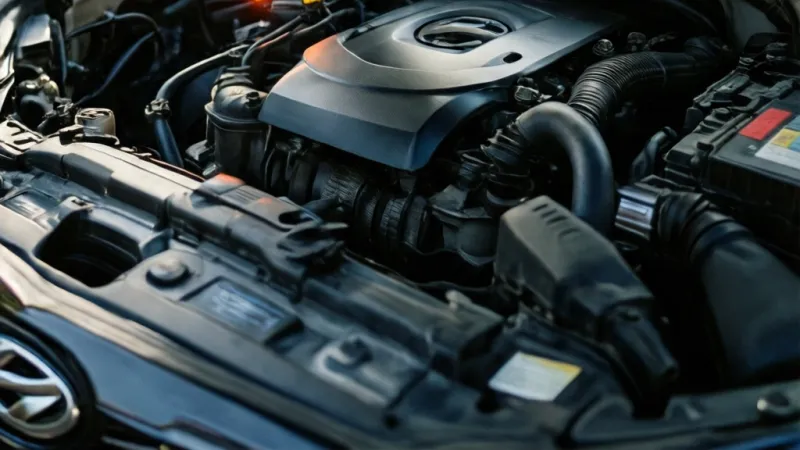
A blinking check engine light on a Hyundai Sonata means an active misfire. Stop driving right away. Get a diagnostic scan for codes like P0300 or P0301 through P0304.
Common causes are worn spark plugs, failed ignition coils, or clogged injectors. Keep driving and you can destroy the catalytic converter.
Why a Blinking Check Engine Light on a Hyundai Sonata Is a Stop-Driving Warning
A blinking light isn't a stronger version of a steady light. It's a different message entirely. The engine control module (ECM) flashes the light when it detects a misfire severe enough to overheat the catalytic converter.
Here's the chain reaction your car is trying to avoid. When a cylinder misfires, the fuel injected into it doesn't burn. That raw gasoline travels down the exhaust and ignites inside the catalytic converter instead.
Catalyst internals are ceramic, and they're designed to handle exhaust gas, not liquid fuel burning on their surface.
Temperatures inside a converter during a sustained misfire can climb well past 1,000°F (538°C). The ceramic substrate can melt, crack, or collapse. Once that happens, the converter is scrap, and you're looking at a repair that runs into four figures.
What Hyundai's Own Guidance Says
Hyundai service documentation treats a flashing malfunction indicator lamp as a stop-driving condition, not a schedule-an-appointment condition. The distinction is deliberate. A steady light usually means an emissions fault that can wait a few days.
A flashing light means damage is accumulating while you drive. Emissions testing will also fail you. More importantly, you could lose power suddenly in traffic.
That's a safety problem, not just a cost problem.
The Real-World Cost of Ignoring It
Aggregate repair data and shop estimates point to a wide cost gap between fixing the cause early and fixing the aftermath. Here's what the two paths typically look like.
| Scenario | Typical Repair | Estimated Cost (USD) |
|---|---|---|
| Fix misfire within days | Spark plugs and one coil | $150 to $450 |
| Fix misfire after weeks | Coils, plugs, plus converter | $1,200 to $2,500+ |
| Severe case | Converter, exhaust, oxygen sensors | $2,500 to $4,000+ |
Costs vary by region, engine, and whether you use OEM or aftermarket parts. The pattern holds either way. Waiting is expensive.
If You're Currently on the Road
Do this, in this order:
- Slow down and signal. Pull off at the next safe spot.
- Shift into Park or Neutral and shut the engine off.
- Do not restart it to see if it clears.
- Turn on your hazard lights and call for a tow if you're not near a shop.
- If the light was blinking and then went solid, that's not a green light. It means the misfire paused, not that the fault is gone.
Blinking vs Solid Check Engine Light: What the Difference Means for Your Sonata
The behavior of the light is itself diagnostic data. Hyundai's ECM uses two modes: steady illumination for stored faults and flashing for active, damaging faults. Reading that correctly saves you from making a bad call in the first thirty seconds.
| Light Behavior | What It Signals | Safe to Drive? | Typical Action |
|---|---|---|---|
| Solid, steady | Stored emissions or sensor fault | Usually yes, short term | Scan soon, schedule repair |
| Blinking, then solid | Misfire was active, now intermittent | No | Scan immediately, avoid driving |
| Blinking continuously | Active misfire right now | No | Pull over, tow it |
| Briefly flashes once at startup | Bulb check | Yes | Normal behavior |
Why the ECM Switches to Flashing Mode
The ECM runs a continuous misfire monitor that counts crankshaft speed variations, cylinder by cylinder. A healthy cylinder fires at a predictable rate. A misfiring one causes the crank to slow slightly on that firing stroke.
When the misfire rate crosses a threshold, roughly 2 to 5 percent of firing events depending on conditions, the ECM lights the lamp. Cross a second, higher threshold, and the ECM switches from steady to flashing. That second threshold is the one Hyundai ties to catalyst damage.
The Trap of the Intermittent Blink
Intermittent misfires are the sneakiest version. The light blinks for ten seconds, then goes steady. The car feels almost normal again.
Many drivers assume it sorted itself out and keep driving.
It didn't sort itself out. Carbon tracking on a coil boot, a partially clogged injector, or a failing ignition coil can misfire only under load or at certain temperatures. Each blink still dumps raw fuel into the converter.
If you see a blink at all, treat the car as unsafe until a technician clears it.
What If the Light Went Out Completely?
If the light is fully off and stays off through several drive cycles, the ECM may have cleared the code itself. That doesn't mean the underlying fault is gone. Pending codes and freeze frame data often remain stored.
Get the vehicle scanned anyway. A shop can read pending codes that a basic handheld reader might miss. This is also the moment when a cheap reader falls short, because Hyundai-specific data lives in manufacturer-defined parameter IDs that generic tools can't reach.
What Causes a Hyundai Sonata Check Engine Light to Blink
A blinking light means misfire. Misfire always traces back to one of three systems: ignition, fuel, or mechanical. Ranking the causes by likelihood helps you and your shop direct effort where it counts.
| Cause | Typical DTCs | Likelihood on Sonata | Notes |
|---|---|---|---|
| Worn or fouled spark plugs | P0300, P0301 to P0304 | High | Most common cause overall |
| Failed ignition coil | P0301 to P0304 | High | Often single-cylinder |
| Faulty fuel injector | P0301 to P0304, P0201 to P0204 | Moderate | Rough idle, fuel smell |
| Vacuum or intake leak | P0300, P0171, P0174 | Moderate | Lean misfire across banks |
| Low compression | P0300 to P0304 | Model-specific | Mechanical, most serious |
| Failed catalytic converter | P0420, P0430 | Usually a consequence | Often the result of ignoring misfire |
| Timing chain or valve issue | P0011, P0016, P0300 | Lower | Can appear on higher-mileage cars |
| Faulty mass airflow sensor | P0101, P0300 | Lower | Causes lean or rich misfire |
Spark Plugs and Ignition Coils
On most Sonata engines, spark plugs are the first suspect. Hyundai's maintenance schedule puts replacement intervals roughly between 60,000 and 100,000 miles depending on engine and plug type. Iridium plugs on turbo and hybrid variants can degrade earlier than the schedule suggests.
Ignition coils fail differently. A coil can test fine cold and break down once the engine bay heats up. That produces a misfire that only appears after ten or fifteen minutes of driving.
A scan at a cold idle sometimes shows nothing.
Fuel Delivery Problems
Clogged or leaking injectors throw off the air-fuel ratio enough to cause a misfire. Symptoms include rough idle, hesitation on acceleration, and a fuel smell that lingers near the tailpipe.
A leaking injector is worse than a clogged one. It can hydro-lock a cylinder in extreme cases and wash oil off cylinder walls, which accelerates ring and bore wear. If a mechanic finds a leaking injector, replace it, don't clean it.
The Theta II Factor
Certain 2011 to 2019 Sonata models use the 2.4L Theta II engine, which was covered by a major recall campaign related to connecting rod bearing failure. That failure mode can cause sudden engine seizure or misfire as bearings degrade.
If your Sonata falls in the affected model years and you're seeing a blinking light, check your VIN against the recall database at NHTSA.gov before anything else. Recall repairs are performed at no cost. This is the one scenario where a blinking light could point to something far more serious than a spark plug.
Age and Mileage Patterns
Aggregate repair reports show clear mileage bands where causes cluster:
- Under 60,000 miles: spark plugs, single coil failure, injector issues
- 60,000 to 120,000 miles: coils, worn plugs, vacuum leaks
- Over 120,000 miles: compression loss, timing components, converter failure from earlier misfires
Knowing the mileage band narrows the diagnosis before the hood ever opens.
Ignition, Fuel, and Mechanical Misfires Explained
Every misfire falls into one of three buckets. The bucket tells you how fast you need to act and how much the fix will cost. A technician's job is to sort the misfire into the right bucket before touching a part.
Ignition Misfires: The Most Common and Most Fixable
An ignition misfire means the spark never happened, or it happened at the wrong time. That's a spark plug, an ignition coil, a coil boot, or wiring to the coil.
These misfires tend to be cylinder-specific. A scan will usually show P0301, P0302, P0303, or P0304, where the last digit indicates which cylinder is at fault.
Ignition misfires often worsen with load. They show up under acceleration or on hills before they show up at idle. If a car misfires only when you push the throttle, ignition is the leading suspect.
Fuel Misfires: Lean, Rich, or Nothing At All
A fuel misfire means the cylinder got the wrong amount of fuel, or none. Possible causes include a clogged injector, a failing fuel pump, a bad fuel pressure regulator, or a vacuum leak that throws off the air-fuel mix.
Fuel misfires show up differently than ignition misfires. They're often accompanied by a fuel smell, black or wet spark plugs, and rough running that gets worse over time rather than in bursts.
A vacuum leak is worth flagging because it's cheap to fix and easy to miss. A cracked intake boot or a failed intake gasket pulls unmetered air into the engine. The ECM sees a lean condition and dumps more fuel, but cylinders get inconsistent mixtures.
That creates random P0300 misfires rather than a single-cylinder code.
Mechanical Misfires: The Serious Category
A mechanical misfire means the engine can't build compression in that cylinder. Causes include worn piston rings, a damaged valve, a failed head gasket, or a broken valve spring.
These are the misfires you can't fix with a tune-up. Compression tests and cylinder leak-down tests confirm the diagnosis. If your Sonata shows a single-cylinder misfire, consumes oil, and produces blue smoke, mechanical wear is likely.
Mechanical misfires are also the ones most likely to cause secondary damage. Unburned fuel enters the exhaust on every stroke, and the converter takes the hit.
Matching Symptoms to Categories
| Symptom | Most Likely Category | Primary Suspect |
|---|---|---|
| Misfire only under load | Ignition | Coil or plug |
| Misfire only when hot | Ignition | Coil heat breakdown |
| Rough idle, fuel smell | Fuel | Injector or pressure |
| Misfire across multiple cylinders | Fuel or intake | Vacuum leak, MAF, fuel pump |
| Constant misfire, oil consumption | Mechanical | Compression loss |
| Misfire plus coolant loss | Mechanical | Head gasket |
This isn't a substitute for a professional diagnosis. It's a way to understand what your shop is looking for, so you can ask the right questions.
How Hyundai's Misfire Monitor and OBD-II Codes Work
Your Sonata's ECM is running a continuous test every time the engine is on. Understanding what that test measures explains why some misfires trigger the light instantly and others take days.
The Crankshaft Variation Test
The misfire monitor measures how much the crankshaft slows after each cylinder's power stroke. A cylinder that fires correctly accelerates the crank by a predictable amount. A misfiring cylinder doesn't.
The ECM compares each firing event to the average across all cylinders. Deviations beyond the calibrated threshold get logged. If enough deviations stack up within a monitoring window, the ECM sets a code.
How Thresholds and Catalyst Damage Interact
Two thresholds matter. The first triggers the steady light. The second triggers the flash.
Hyundai, like every manufacturer selling in the US, follows emissions regulations set by the EPA and the standard OBD-II protocol defined by SAE J1979.
The flashing threshold is calibrated to prevent catalyst overheating. If the misfire rate is high enough that converter temperatures exceed a safe ceiling, the light flashes. That's the ECM protecting hardware, not just reporting a fault.
Codes You'll Actually See
| Code | Meaning | Cylinder or System |
|---|---|---|
| P0300 | Random or multiple misfires | All cylinders |
| P0301 to P0304 | Cylinder-specific misfire | Cylinder 1, 2, 3, or 4 |
| P0420, P0430 | Catalyst efficiency below threshold | Bank 1 or Bank 2 |
| P0171, P0174 | System too lean | Bank 1 or Bank 2 |
| P0201 to P0204 | Injector circuit open | Corresponding cylinder |
| P0351 to P0354 | Ignition coil circuit malfunction | Corresponding cylinder |
P0420 and P0430 are usually the aftermath, not the cause. They show up weeks or months after an ignored misfire has cooked the converter.
Freeze Frame Data: The Part Most Drivers Never See
When the ECM sets a code, it captures a snapshot of conditions at the moment of the fault. This freeze frame includes engine RPM, coolant temperature, throttle position, load, vehicle speed, and fuel trim values.
Freeze frame data is powerful because it shows the misfire in context. A misfire at 55 mph under light load points somewhere different than a misfire at idle with the AC on.
If your shop doesn't show you the freeze frame, ask for it. Any competent diagnostic process should include it.
Mode 06 Data and Misfire Counters
Mode 06 is a lesser-known OBD-II mode that returns manufacturer-specific test results. Hyundai populates Mode 06 with per-cylinder misfire counters. A shop with a capable scan tool can read how many misfires each cylinder logged during the last drive cycle.
This is useful for intermittent problems. A cylinder showing 400 misfires over a 500-mile cycle while others show zero is the culprit, even if the code hasn't set again yet.
Drive Cycles and Readiness Monitors
After a repair, the ECM needs a specific drive cycle to confirm the fix and turn off the light. That cycle involves starting cold, idling, accelerating under load, cruising at steady speed, and then coasting.
Hyundai drive cycles vary by engine and model year. A shop using the Hyundai Global Diagnostic System (GDS) can tell you exactly what the ECM needs. If the light stays on after a correct repair, the readiness monitors probably haven't completed yet.
That's not a failed fix.
The Real Risks of Driving With a Blinking CEL
Every minute you drive with an active misfire costs money. The question is how much, and how fast. Three separate damage paths are running at the same time, and each one has its own clock.
Catalytic Converter Meltdown
This is the big one. Raw fuel enters the converter, ignites on the substrate, and pushes temperatures past the ceramic's design limit. Internal temperatures can exceed 1,400°F (760°C) during a sustained misfire.
The substrate is a honeycomb of thin ceramic coated with platinum, palladium, and rhodium. It doesn't handle localized hot spots well. Once a section melts or cracks, exhaust flows around the damaged area instead of through it, and efficiency collapses.
The ECM will eventually throw P0420 or P0430 to confirm the damage. By then, the repair is on you unless the car is still under the federal emissions warranty. That warranty covers the converter for 8 years or 80,000 miles on most vehicles.
That's a claim worth checking before you pay out of pocket.
Bore Wash and Cylinder Wall Damage
Fuel that doesn't burn has to go somewhere, and some of it slips past the piston rings into the crankcase. On its way down, it washes the oil film off the cylinder walls.
That sounds minor until you think about what the oil film does. It's the only thing separating metal rings from a metal bore at 2,000+ RPM. Strip it away and you get metal-on-metal contact, which accelerates ring wear and, eventually, compression loss.
Fuel dilution also thins your engine oil. Check the dipstick after a misfire event. If the oil smells like gasoline, change it immediately.
Fuel-thinned oil stops protecting bearings, and that path leads to rod knock.
Exhaust System and Sensor Damage
Sustained converter overheating doesn't stay contained. Heat radiates outward to the exhaust piping, the oxygen sensors, and the underbody shielding. Oxygen sensors (both upstream and downstream) can fail from prolonged heat exposure.
A failed upstream O2 sensor throws off fuel trims, which can make the misfire worse. A failed downstream sensor triggers a permanent CEL. Replacing both sensors plus a converter pushes the bill past $2,000 on its own.
Fire and Safety Risk
The risk of an actual vehicle fire from a misfire is low, but it isn't zero. Unburned fuel collecting in a hot exhaust system can ignite in rare circumstances, especially with an existing exhaust leak.
The more realistic safety issue is sudden power loss. A severe misfire can drop engine output enough that you can't accelerate out of a merging situation. On a highway on-ramp, that matters.
The Emissions Test Problem
If you live in a state with OBD-II emissions testing, a blinking CEL is an automatic fail. The ECM won't have completed all readiness monitors, and stored misfire codes are grounds for rejection. You can't legally register the car until the repair is done and monitors reset.
Risk Timeline Snapshot
| Duration of Driving | Typical Outcome | Cost Range |
|---|---|---|
| Minutes to a few hours | Misfire only, no secondary damage | $100 to $450 |
| A few days to a week | Coil/plug wear, minor sensor stress | $300 to $700 |
| Several weeks | Converter damage starts | $1,200 to $2,000 |
| Months | Converter failure, O2 sensor death | $2,000 to $4,000+ |
The timeline isn't precise. Some converters survive a lot. Others die after an hour.
Treat every hour of driving as a gamble on a part that costs more than a set of tires.
What to Do First: Safe Pull-Over and Pre-Diagnosis Steps
Panic driving is the worst thing you can do. Slow down, get off the road, and shut it off. Here's the sequence that keeps you, your car, and your wallet in the best possible shape.
Step 1: Pull Over Safely
Signal early and move to the shoulder or a parking lot. Don't slam on the brakes. A misfiring engine can stall unexpectedly, and losing power steering mid-maneuver is dangerous.
If you're on a highway with no safe shoulder, take the next exit even if it's a mile away. Driving on a misfire for another mile is far less risky than stopping in a live lane.
Step 2: Shut the Engine Off
Turn the key or push the button to off. Don't let it idle to see if it clears. Idling still pumps raw fuel into the converter on every misfiring stroke.
Wait a few minutes before popping the hood. The engine bay will be hot, and you don't want to burn your hands on a coil or a manifold.
Step 3: A Quick Visual Check
This is triage, not diagnosis. You're looking for anything obvious.
- Loose or missing gas cap (rarely a misfire cause, but free to check)
- Visible smoke from the tailpipe (blue, white, or black)
- Coolant pooling under the car
- Oil level on the dipstick
- Any burning smell, especially sweet or acrid
- Loose wiring or a disconnected harness near the engine
None of these confirm a diagnosis. They just tell you whether it's safe to try restarting at all.
Step 4: Decide Whether to Drive It
If you have any of the following, do not restart the engine. Call for a tow.
- Coolant loss or overheating sign
- Blue or white smoke from the exhaust
- Visible oil leaking from the block or head area
- Metallic knocking or rattling
- The engine won't crank
If the light was blinking and stopped, and the car idles smoothly, you can sometimes limp it to a nearby shop at low speed. Even then, this is a judgment call. Our advice is to tow it.
A $100 tow beats a $2,000 converter.
Step 5: Prep for the Shop
While you wait, gather what will help the technician:
- Photo of the dashboard with the light behavior (blinking or steady)
- The model year, engine size (2.4L, 2.0T, 2.5L, or Hybrid), and current mileage
- Anything you noticed before the light came on (rough idle, hesitation, new noise, fuel smell)
- Whether you recently fueled up, replaced a part, or had any work done
- Whether the car has ever been in for the Theta II engine recall
Pre-Diagnosis Tools You Can Use at Home
If you own a basic OBD-II scanner, you can pull codes before the car goes to a shop. That said, a handheld reader has real limits on a Hyundai.
| Tool Type | Cost | What It Can Read | What It Misses |
|---|---|---|---|
| Basic code reader | $20 to $60 | Stored P, B, C, U codes | Live data, pending codes, Mode 06 |
| Mid-tier scanner | $80 to $200 | Stored and pending codes, live data | Mode 06, bidirectional controls |
| Advanced scan tool | $300 to $1,500+ | Full live data, freeze frame, Mode 06 | Programming, some OEM functions |
| Hyundai GDS (dealer) | Service-only | Everything the ECM supports | Not sold to consumers |
If you're going to buy a scanner for a Hyundai, verify it supports CAN bus protocol and Mode 06 data. Any modern Sonata (2008 and later) uses CAN for OBD-II communication.
How a Shop Diagnoses a Blinking CEL on a Hyundai Sonata
A proper diagnosis follows a path, not a guess. Good shops run a specific sequence that keeps you from paying for parts you didn't need. Here's what that sequence looks like and why each step matters.
Step 1: Verify the Complaint and Check for Recalls
A technician should confirm the light is still an issue and check your VIN against open recalls. The Theta II engine campaign is the priority check. If a recalled engine is in the misfire stage, the path forward changes completely.
If you're in the affected VIN range and the engine is confirmed at fault, the repair is covered. Don't let a shop start billable work before that check happens.
Step 2: Pull Codes and Freeze Frame
The scan tool taps the OBD-II port under the dash. Codes are read and recorded. Freeze frame is captured.
If the tool supports it, Mode 06 data is pulled.
A single P0302 is a very different picture than P0300 plus P0171. The first points to one cylinder. The second suggests a systemic issue like a vacuum leak or fuel delivery problem.
Step 3: Visual Inspection Under the Hood
The technician checks for the obvious: cracked intake tubes, disconnected vacuum lines, oil-fouled plugs, chafed coil wiring, coolant in the plug wells. This step takes ten minutes and often finds the cause without any testing.
On Hyundai Sonatas with coil-on-plug ignition, oil in the plug well from a leaking valve cover gasket is a common finding. Oil degrades the coil boot, causes carbon tracking, and produces a misfire without setting a coil code.
Step 4: Spark Plug and Coil Inspection
Plugs come out and get inspected. Condition tells a story:
- Light tan or gray: normal
- Black and wet: fuel fouling, injector issue
- Black and sooty: rich mixture
- Oily: valve guide or ring wear
- White or blistered: overheating or lean condition
- Cracked porcelain or eroded electrode: internal wear
Coils get swapped to a known-good cylinder as a diagnostic step. If the misfire follows the coil, the coil is bad. If it stays in the same cylinder, the problem is downstream (fuel or mechanical).
Step 5: Compression and Leak-Down Testing
If ignition and fuel check out, compression becomes the focus. A dry compression test establishes baseline pressure per cylinder. A wet test (adding a teaspoon of oil to the cylinder) shows whether the loss is from rings or valves.
A leak-down test is more precise. The cylinder is pressurized with air and the leak rate is measured. You can also hear where the air escapes:
- Air from the oil fill cap: worn rings or piston
- Air from the intake: bad intake valve
- Air from the exhaust: bad exhaust valve
- Bubbles in the coolant: head gasket
Step 6: Fuel System Verification
Injectors get tested for resistance, spray pattern, and balance. Fuel pressure is checked at the rail. A fuel pressure drop after the pump primes can indicate a leaking injector or a failing check valve.
Vacuum leaks get found with a smoke machine. A shop introduces smoke into the intake and watches where it escapes. This method catches leaks that are nearly impossible to find by sound or sight alone.
Typical Diagnostic Flow
| Step | What It Checks | Time | Cost |
|---|---|---|---|
| Scan and freeze frame | Codes and conditions | 15 min | $75 to $150 |
| Visual inspection | Obvious faults | 10 min | Included |
| Plug/coil inspection | Ignition system | 30 min | Included |
| Compression/leak-down | Mechanical condition | 45 min | $100 to $200 |
| Fuel and vacuum tests | Delivery and leaks | 30 min | $100 to $200 |
A full diagnostic session usually runs $150 to $250 total. Some shops credit the diagnostic fee toward the repair if you approve the work.
Scan Tool Data That Pinpoints the Cause: P0300–P0304, P0420, and Freeze Frame
The scan tool is a window into the ECM. Understanding what the data means turns a guess into an answer. Here's how to read the numbers.
Misfire Counters in Mode 06
Mode 06 returns per-cylinder misfire counts for the last monitoring cycle. A healthy engine shows zero or single-digit counts on every cylinder. A cylinder with hundreds or thousands of counts while others sit at zero is your culprit.
Counts are cumulative and reset with the monitoring cycle. If you scan immediately after a misfire event, you'll see them. If you scan a week later, the ECM may have cleared them.
Fuel Trim Values
Short-term fuel trim (STFT) and long-term fuel trim (LTFT) tell you how much the ECM is adding or pulling fuel to hold stoichiometry. Normal is within plus or minus 10 percent.
| Trim Reading | Likely Meaning |
|---|---|
| LTFT +15% or higher at idle | Vacuum leak |
| LTFT +15% or higher at cruise | Fuel delivery issue or MAF fault |
| LTFT -15% or lower | Rich condition, leaking injector, MAF overreporting |
| High trim on one bank only | Bank-specific issue (injector, intake gasket, sensor) |
A vacuum leak shows up strongest at idle because manifold vacuum is highest there. A weak fuel pump or clogged filter shows up under load when fuel demand is peak.
Freeze Frame Snapshot
Freeze frame stores the operating conditions when the code set. Key values to look at:
- Engine RPM at fault
- Engine coolant temperature
- Vehicle speed
- Calculated engine load
- Throttle position
- STFT and LTFT at fault
- Intake air temperature
A misfire logged at 2,500 RPM with 60 percent load points to ignition under stress. A misfire at 700 RPM idle with LTFT +18 percent points to a vacuum leak.
Oxygen Sensor Readings
Upstream O2 sensors should oscillate rapidly between roughly 0.1V and 0.9V. A lazy sensor that swings slowly or flatlines indicates a failing sensor or wiring issue.
Downstream O2 sensors should hold a steady reading between 0.6V and 0.8V. If the downstream sensor mirrors the upstream sensor's oscillation, the converter isn't filtering exhaust properly. That's the classic precursor to P0420.
Ignition Coil and Injector Data
Live data on a capable scanner shows ignition timing per cylinder, coil dwell time, and injector pulse width. An injector with a longer pulse width than its neighbors is compensating for a restricted flow path. A coil with a shorter dwell than spec may be failing internally.
Putting It Together
| Data Pattern | Most Likely Cause |
|---|---|
| P0301, single-cylinder misfire counter high, good compression | Ignition coil or plug |
| P0300, LTFT +20% at idle | Vacuum leak |
| P0300, low fuel pressure under load | Fuel pump or filter |
| P0301, high misfire count, oily plug | Valve seal or ring wear |
| P0420 after a recent misfire event | Converter damage from earlier fuel burning |
No single data point confirms a diagnosis. The combination points to a category, and testing within that category pins the part.
Repair Costs for Common Blinking CEL Causes
Numbers move around by region, engine, and whether you use OEM or aftermarket parts. The figures below reflect typical US independent shop pricing as of 2026 for a Hyundai Sonata.
| Repair | Parts Cost | Labor (Hours) | Total Range |
|---|---|---|---|
| Spark plugs (4-cylinder set) | $40 to $120 | 1 to 2 | $150 to $350 |
| Ignition coil (one) | $60 to $180 | 0.5 to 1 | $120 to $300 |
| All four coils | $240 to $720 | 1 to 2 | $400 to $1,000 |
| Fuel injector (one) | $80 to $250 | 1 to 3 | $200 to $600 |
| All four injectors | $320 to $1,000 | 3 to 5 | $700 to $1,800 |
| Vacuum leak repair | $5 to $80 | 0.5 to 2 | $80 to $300 |
| Ignition coil wiring harness | $80 to $250 | 1 to 2 | $200 to $500 |
| Timing chain service | $300 to $800 | 5 to 8 | $1,000 to $2,200 |
| Catalytic converter (OEM) | $700 to $1,800 | 1 to 3 | $1,200 to $2,500 |
| Catalytic converter (aftermarket) | $250 to $700 | 1 to 3 | $600 to $1,400 |
| Oxygen sensor (upstream) | $60 to $200 | 0.5 to 1 | $150 to $350 |
What Drives the Price Up
A few factors push costs higher than the baseline:
- Turbocharged 2.0T engines have tighter engine bays and pricier coils
- Hybrid Sonata models add high-voltage precautions and different component pricing
- Dealer labor rates (typically $150 to $220 per hour) run above independent shops
- OEM parts on emissions components are often required for warranty compliance on California-emissions vehicles
- If the misfire caused secondary damage, you pay for both repairs
What Keeps the Price Down
- Catching it early before the converter fails
- Getting a real diagnostic instead of throwing parts at it
- Using a trustworthy independent shop with Hyundai experience
- Checking for open recalls and warranty coverage first
Warranty Coverage to Check
Before you approve any repair, verify:
| Warranty | Coverage |
|---|---|
| Federal emissions (converter and major emissions parts) | 8 years or 80,000 miles |
| California emissions (CARB states) | 7 years or 70,000 miles for some parts, 15 years or 150,000 for others |
| Hyundai powertrain (original owner) | 10 years or 100,000 miles |
| Hyundai powertrain (subsequent owners) | 5 years or 60,000 miles |
| Theta II engine recall | Varies by VIN, covers specific engine failures |
The powertrain warranty doesn't cover spark plugs, coils, or injectors, but it does cover internal engine damage from a manufacturing defect. If a Theta II bearing failure caused your misfire, that's a warranty claim, not a repair bill.
When Repair Costs Exceed Value
On a very high-mileage Sonata with a failed converter, a compression problem, or multiple simultaneous faults, the repair could approach the car's value. Get a written estimate and compare it against trade-in or private-party value before committing. Sometimes the responsible call is to sell it, and that's a decision the numbers should drive, not emotion.
DIY vs Dealer vs Independent Shop: Choosing Your Repair Path and Parts
Not every repair needs a dealer. Not every repair is DIY-safe either. The right path depends on what's actually broken, how much tooling it takes, and whether the fix might be covered under warranty or recall.
Here's how the three options stack up for a Hyundai Sonata with an active misfire.
| Factor | DIY | Independent Shop | Hyundai Dealer |
|---|---|---|---|
| Hourly labor rate | $0 | $90 to $160 | $150 to $220 |
| Hyundai-specific expertise | Variable | Often good, varies by shop | Guaranteed |
| Scan tool capability | Basic to mid-tier | Advanced aftermarket | Hyundai GDS |
| OEM parts availability | Online, delayed | Often stocked | Same day |
| Warranty and recall handling | You handle it | They can submit | Full authority |
| Diagnostics depth | Limited | Full | Full plus software updates |
| Best for | Simple ignition work | Most misfire repairs | Recalls, warranty, complex faults |
Who Each Path Is Right For
DIY makes sense if you're already comfortable with basic hand tools and the diagnosis points to spark plugs or a single coil. Those jobs are straightforward on most Sonata engines and don't require lifting the car.
An independent shop is the sweet spot for most people. A good independent will have a capable scan tool, can read Mode 06 data, and will charge less than a dealer without cutting corners on the diagnosis.
The dealer is the right call when a recall is in play, when you're pursuing warranty coverage, or when the diagnosis is genuinely hard. Hyundai GDS gives the dealer access to manufacturer-specific data that aftermarket tools can't see. That includes software updates that fix drivability issues on certain model years.
When DIY Crosses the Line
Some repairs look simple on YouTube and aren't. Injector replacement on a direct-injection Sonata requires sealing washers, specific torque values, and careful handling of high-pressure fuel lines. Get it wrong and you're looking at a fuel leak near a hot engine.
Timing chain work, compression faults, and anything involving the head gasket are beyond DIY scope. These jobs need specialized timing tools, careful measurement, and experience with the platform.
OEM vs Aftermarket Parts
| Part | OEM Recommendation | Aftermarket Acceptability |
|---|---|---|
| Spark plugs | Match OEM spec exactly | Good if from a known brand with correct heat range |
| Ignition coils | OEM or OE-equivalent | Acceptable for non-turbo; stick OEM for 2.0T |
| Fuel injectors | OEM strongly preferred | Rebuilt units vary widely in quality |
| Catalytic converter | OEM on CARB vehicles | Federal-certified aftermarket only if legal in your state |
| Oxygen sensors | OEM | Denso or NTK equivalents work well |
The pattern is consistent. Ignition and sensor parts have good aftermarket options. Emission-critical parts in California-emissions states need to meet stricter standards.
A non-compliant converter is illegal to install and will fail inspection.
Questions to Ask Any Shop Before You Hand Over the Keys
- Do you have a scan tool that can read Mode 06 data?
- Will you show me the freeze frame before you start replacing parts?
- What's the diagnostic fee, and is it credited toward the repair?
- Are you checking for open recalls on my VIN first?
- Will you use OEM or aftermarket parts, and why?
- Can you give me a written estimate before doing anything else?
A shop that can't answer those clearly isn't the right shop for a misfire diagnosis.
Mistakes That Turn a Misfire Into a Dead Catalytic Converter
The difference between a $300 repair and a $2,000 repair usually comes down to what the driver and the shop do in the first 48 hours. Here are the mistakes that show up again and again.
Driving It Anyway Because It Feels Fine
The engine doesn't always feel bad. A single-cylinder misfire at highway speed is often masked by the other three cylinders doing their job. The car cruises fine, the light blinks, and the driver assumes it's a sensor glitch.
It's not a glitch. The raw fuel hitting the converter doesn't care how smooth the car feels. This is the single most common path to a dead catalyst.
Clearing the Code Instead of Fixing It
Clearing the code turns off the light. It doesn't stop the misfire. The ECM will re-detect the misfire within one or two drive cycles and set the code again, usually with a fresh flash.
Worse, clearing codes wipes readiness monitors and pending codes. That makes diagnosis harder for the next shop and can hide the trail that would have led straight to the cause.
Throwing Parts at It Without Diagnosing
Replacing all four coils and all four plugs just to be safe is a common approach, and occasionally it works. More often it means the actual fault, say a vacuum leak or a weak injector, is still there when the light comes back on.
Parts-canon diagnostics cost real money. A $150 diagnostic fee that identifies the one bad part is cheaper than $600 in parts that weren't the problem.
Mixing Up the Cylinder Numbering
Hyundai's cylinder numbering on inline four-cylinder Sonata engines runs from the timing-belt or chain end. If a shop or a DIYer misidentifies which cylinder is which, they can replace a perfectly good coil on the wrong cylinder and leave the real fault untouched.
Check the service manual for your specific engine. The numbering isn't universal across manufacturers, and assuming can cost you a converter.
Ignoring Fuel Dilution in the Oil
Most people never think about what a misfire does to the oil. Fuel that leaks past the rings thins the oil and reduces its ability to protect bearings and cam lobes.
If you've been driving with a misfire for more than a day or two, change the oil after the repair. It's cheap insurance against accelerated engine wear that shows up thousands of miles later.
Skipping the Post-Repair Drive Cycle
A repair isn't done when the part is installed. The ECM needs a proper drive cycle to confirm the fix and clear the light. If the shop just clears the code and hands the keys back, the light will come on again.
Ask the shop to complete the drive cycle before you pick up the car. If they can't, ask them to explain what monitors still need to run.
Not Verifying That the Converter Survived
If you drove on the misfire for weeks, the converter might be compromised even after the misfire is fixed. Downstream O2 sensor behavior confirms it. If the converter is degraded, you'll get P0420 within a few hundred miles of the repair.
Not every shop checks this proactively. Ask them to verify downstream O2 activity after the repair so you don't get a surprise code a month later.
The Mistakes That Cost the Most
| Mistake | Typical Consequence | Estimated Extra Cost |
|---|---|---|
| Driving on a flashing light | Converter damage | $1,000 to $2,500 |
| Clearing codes repeatedly | Delayed diagnosis, hidden damage | $200 to $500 |
| Parts-canon repair | Wasted parts, recurring fault | $300 to $800 |
| Wrong cylinder targeted | Unfixed fault, more damage | $200 to $1,500 |
| Skipped oil change after misfire | Accelerated engine wear | $1,000+ long term |
| No post-repair drive cycle | False repaired status | Diagnostic repeat fee |
Most of these mistakes share a root cause. Speed. Fixing it fast feels productive.
But diagnosis is what actually saves time and money here.
Warranty, Recalls, and Emissions Compliance for Your Sonata
Before you spend a dime, find out what someone else might pay for. Hyundai has issued substantial coverage extensions and recalls on certain Sonata model years. Emissions components carry their own federally mandated warranties.
Checking for Open Recalls
Enter your VIN at the NHTSA recall lookup or the Hyundai owner portal. Both are free and take two minutes. If a recall applies, the repair is at no cost regardless of mileage.
The Theta II engine campaign is the big one for Sonata. Certain 2011 to 2019 models with the 2.4L and 2.0L turbo engines were covered for connecting rod bearing failure. A related knock sensor detection system was also installed on affected vehicles to warn drivers before catastrophic failure.
If the knock sensor system has triggered a limp mode or warning, get it to a dealer immediately. This is not a drive-it-and-see situation.
Federal and California Emissions Warranties
Emissions components get longer coverage than most people realize. The federal Clean Air Act sets minimum standards, and California sets stricter ones.
| Component | Federal Coverage | California Coverage |
|---|---|---|
| Catalytic converter | 8 years / 80,000 miles | 7 years / 70,000 miles (some parts longer) |
| ECM / PCM | 8 years / 80,000 miles | 7 years / 70,000 miles |
| Oxygen sensors | 2 years / 24,000 miles | 3 years / 50,000 miles |
| Ignition components | 2 years / 24,000 miles | 3 years / 50,000 miles |
| General emissions parts | 2 years / 24,000 miles | 3 years / 50,000 miles |
If your Sonata is still inside those windows and the converter or ECM failed, the manufacturer may be on the hook. Save your repair records either way. You may need them to prove the failure happened within the coverage window.
Hyundai Powertrain Warranty
Original owners get 10 years or 100,000 miles. Subsequent owners get 5 years or 60,000 miles. The coverage applies to engine internals, transmission, and drivetrain components, not to wear items like plugs and coils.
Here's the key distinction. If a manufacturing defect caused a misfire that led to engine damage, that's a powertrain claim. If a worn spark plug caused the misfire, that's routine maintenance and you pay for it.
Right to Repair and Your Data
Federal right-to-repair rules mean you can have your Sonata serviced at an independent shop without voiding your warranty. The Magnuson-Moss Warranty Act protects that right. A dealer can't deny a warranty claim simply because someone else did the oil change.
That said, keep receipts. If a warranty claim gets disputed, documentation showing the work was done correctly is what wins the argument.
Emissions Testing Compliance by State
If you live in a state with OBD-II testing, a blinking light means an automatic fail. The ECM must have completed all readiness monitors before the test, and stored misfire codes are grounds for rejection.
| State Type | Requirement | Getting Through |
|---|---|---|
| OBD-II states (most) | No stored codes, monitors complete | Repair, drive cycle, retest |
| California (CARB) | Stricter standards, CARB-certified parts required | Repair with compliant parts |
| Non-testing states | No emissions inspection | Still illegal to tamper with emissions equipment |
Even in non-testing states, removing or disabling emissions equipment is a federal violation. That includes deleting a catalytic converter or installing a test pipe in its place. Fines can run into the thousands.
When to Involve Hyundai Corporate
If your Sonata is out of warranty but the failure matches a known defect, you can sometimes get partial or full coverage by contacting Hyundai Consumer Affairs. Recalls and coverage extensions exist precisely because enough owners reported a pattern.
Bring your service records, VIN, mileage, and a clear description of the fault. Be factual. Complaints backed by documentation get better outcomes than complaints based on frustration alone.
Maintenance That Prevents Blinking CEL Misfires
Most blinking CEL events are preventable. The maintenance schedule in your owner's manual isn't just for oil changes. It's the roadmap that keeps ignition, fuel, and emissions systems healthy enough to avoid misfires in the first place.
Spark Plug Replacement on Schedule
Spark plugs degrade gradually. They don't fail overnight, but they do lose their ability to fire reliably under load.
| Engine | Plug Type | Typical Interval |
|---|---|---|
| 2.4L Theta II | Iridium | 60,000 to 100,000 miles |
| 2.0L Turbo | Iridium | 45,000 to 60,000 miles |
| 2.5L Smartstream | Iridium | 60,000 to 100,000 miles |
| Hybrid | Iridium | 60,000 to 100,000 miles |
Turbo engines eat plugs faster because of higher cylinder pressures and temperatures. If you drive a 2.0T Sonata and push it hard, don't wait for the manual's maximum interval.
Ignition Coil Inspection
Coils don't have a fixed replacement interval, but they do have a lifespan. On a Sonata, coil failures often start between 80,000 and 150,000 miles. Some last longer.
Watch for the signs: hesitation under load, a rough idle that improves with RPM, or a single-cylinder misfire code. If one coil fails at high mileage, the others are likely close behind. Many shops recommend replacing coils in pairs or as a set at that point.
Keeping the Intake System Sealed
Vacuum leaks cause lean misfires that are hard to diagnose. The parts that fail most often are the intake manifold gasket, the throttle body gasket, and any rubber vacuum lines.
Inspect rubber lines at every oil change. They harden and crack with age, especially in hot climates. A $5 hose that's cracked can cause a misfire that costs hundreds to diagnose.
Fuel System Care
Fuel injectors clog over time, especially with lower-quality fuel or infrequent driving. A bottle of fuel system cleaner every 15,000 to 30,000 miles helps, though it won't fix a badly clogged injector.
Replace the fuel filter at the interval in your owner's manual. On some Sonata generations, the filter is in the tank and considered a long-life item. On others, it's an inline filter with a service interval.
Oil Changes and Their Role in Misfire Prevention
Clean oil keeps the variable valve timing system working correctly. Dirty oil or low oil pressure can cause VVT faults and misfires on Hyundai engines. On the 2.4L and 2.0L Theta II engines, oil changes every 5,000 to 7,500 miles with the correct viscosity is cheap insurance.
Check oil level monthly. Oil consumption on the Theta II is a known issue on some model years. Running low accelerates wear and increases the chance of a misfire developing from mechanical causes.
Annual Preventative Checks
A few minutes once a year catches problems before they turn into misfires:
- Inspect ignition coil boots for cracks and carbon tracking
- Check spark plug condition at every 30,000-mile milestone (even if not replacing)
- Listen for a rough idle with a stethoscope or by feel
- Look for coolant loss or oil seepage around the valve cover
- Test the battery and charging system
- Run a code scan even when there's no light on
That last one matters most. Pending codes show up before the light comes on. Catching a misfire at pending stage lets you fix it on your schedule instead of on the side of the road.
Maintenance Costs vs Repair Costs
| Maintenance Item | Cost | Potential Avoided Repair |
|---|---|---|
| Spark plug replacement | $150 to $350 | $1,200+ converter job |
| Coil replacement (preventative, one) | $120 to $300 | $300 to $600 misfire repair |
| Oil change (every 5,000 miles) | $60 to $100 | $1,000+ engine wear |
| Fuel system cleaner | $10 to $30 | $300+ injector service |
| Annual scan and inspection | $50 to $150 | Variable, often hundreds |
You don't need to be a mechanic to keep a Sonata healthy. You just need to follow the schedule and pay attention when something feels off.
Frequently Asked Questions
Can I drive my Hyundai Sonata with a blinking check engine light?
No. A blinking light means an active misfire that's dumping raw fuel into the catalytic converter. Every mile you drive risks overheating and destroying a part that costs $1,000 or more to replace.
Pull over safely and have the car towed.
What code does a blinking check engine light usually mean on a Sonata?
P0300 is the most common. It indicates random or multiple misfires across cylinders. Cylinder-specific codes P0301 through P0304 show up when the misfire is isolated.
Sometimes P0171 or P0174 appear alongside P0300 if the cause is a vacuum leak or fuel delivery issue.
How much does it cost to fix a blinking check engine light on a Sonata?
Caught early, repairs typically run $150 to $450 for spark plugs and a coil. If the misfire has damaged the catalytic converter, the bill climbs to $1,200 to $2,500 or more. Diagnostics usually add $150 to $250, though many shops credit that toward the repair.
What happens if I keep driving with a blinking check engine light?
The catalytic converter overheats and the ceramic substrate can melt or crack. You'll also get fuel dilution in the oil, which accelerates engine wear. Eventually you'll see P0420 or P0430 codes confirming the converter damage.
The repair bill roughly quadruples compared to fixing the misfire early.
Does a blinking check engine light always mean the catalytic converter is bad?
No. A blinking light means an active misfire that's threatening the converter. The converter is usually still fine if you stop driving right away.
Once the misfire is repaired, downstream oxygen sensor readings confirm whether the converter survived. Most do if the driver acts quickly.
Is a blinking check engine light covered by Hyundai warranty?
The repair may be covered if your Sonata is under the federal emissions warranty (8 years or 80,000 miles for the converter and ECM) or the powertrain warranty for internal engine faults. Recall-related failures like the Theta II connecting rod bearing issue are covered regardless of mileage. Spark plugs, coils, and injectors are not.