A vw blinking temperature light is one of those warnings you can't ignore. It might mean your engine is overheating right now. It might also mean the coolant level sensor has gone bad.
The difference matters, because one of those can destroy an engine in minutes.
Manufacturer specifications indicate VW's coolant warning thresholds sit around 105°C to 120°C, well above the normal 90°C (194°F) operating temperature. That gap is your safety window. A blinking light is your cue to use it.
Here's how to read the warning correctly and decide what to do next.
Quick Answer
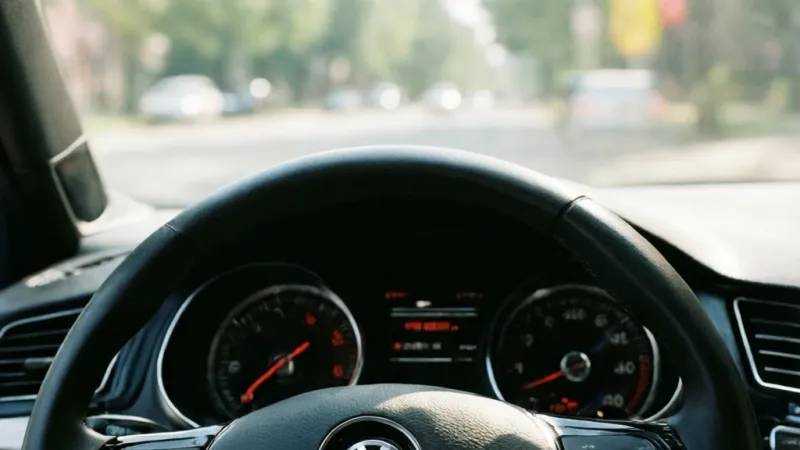
A vw blinking temperature light means stop and check coolant now. Blinking red signals low coolant or overheating. Solid red means the engine is too hot.
Blue means the engine is cold and normal. Do not keep driving on blinking red.
Why Your VW Temperature Light Blinks (And Why Color Changes Everything)
VW uses one warning icon for several different conditions. That icon looks like a thermometer sitting in liquid. The color and behavior of that icon tell you what's actually happening.
A blinking red light is the most urgent state. It usually means coolant level is critically low. It can also mean the engine is overheating or the level sensor is failing.
The blinking pattern is deliberate, designed to grab attention faster than a solid light.
A solid red light is slightly less urgent but still serious. It typically means engine temperature has climbed above a safe threshold. You need to pull over soon, but you may have more time than a blinking light allows.
A blue light is completely different. It comes on when the engine is cold, usually at startup on a cold morning. It goes out once the coolant reaches normal operating temperature.
Blue is normal, not a warning.
What Each Light State Actually Means
| Light Behavior | Color | Typical Meaning | Urgency |
|---|---|---|---|
| Blinking | Red | Low coolant, overheat, or sensor fault | Stop now |
| Solid | Red | Engine above safe temp | Pull over soon |
| Solid | Blue | Cold engine, normal warm-up | None |
| Off | Any | System normal | None |
The blinking state is the one people panic about. It's also the one that gets misdiagnosed the most. A blinking light doesn't automatically mean your head gasket is gone.
In our research across VW service bulletins and owner reports, low coolant from a slow leak is the most common cause.
If the coolant is topped off and the light still blinks, the level sensor is the next suspect. That sensor sits inside the expansion tank and uses a magnetic float. When the float sticks or the wiring corrodes, the cluster sees a false low-level signal.
Cold weather makes this worse. Coolant contracts when it's cold, so a system that's slightly low in summer can trigger the warning on a 20°F morning. That's why VW recommends checking coolant level with the engine cold and the car parked on level ground.
How the VW Coolant Warning System Actually Works
VW's coolant warning system is more layered than most drivers realize. Three separate sensors feed data to the engine control module. The module then decides whether to trigger the light, the gauge, or both.
The first sensor is the Engine Coolant Temperature sensor, known as G62 in VW's naming system. It sits on the coolant outlet and reports actual coolant temperature to the ECM. This is the sensor that drives the temperature gauge and the overheat warning.
The second is the radiator outlet coolant temperature sensor, or G83. It measures the temperature of coolant leaving the radiator. The ECM compares G62 and G83 readings to calculate how well the radiator is cooling.
If the two readings diverge, the ECM may flag a thermostat fault.
The third is the coolant level sensor, or G32. It lives inside the expansion tank and detects low coolant. On most VW models, this is a simple magnetic reed switch that floats up and down with the coolant level.
How the Signals Travel
All three sensors report back to the engine control module, listed as J623 in VW's wiring diagrams. The ECM uses that data to control the radiator fan, the thermostat on map-controlled units, and the warning light itself.
The warning light lives in the instrument cluster, or J285. The ECM sends a message to the cluster over the CAN bus. That message tells the cluster to display the coolant icon, the temperature gauge position, and any text alerts like "Check coolant level."
This is why a cluster fault can produce the same warning as a real overheat. If the CAN message gets corrupted, or the cluster has a coding issue, you can see a blinking light with no actual coolant problem. That's rare but documented.
Fault Codes You'll See
A scan tool is the fastest way to separate a real problem from a sensor glitch. VW-specific tools like VCDS or OBDeleven read more codes than a generic OBD-II scanner. Per SAE J1979, the standard that governs OBD-II communication, generic scanners only see emissions-related codes.
Common coolant-related fault codes include:
- P0116: Engine coolant temperature circuit range or performance
- P0117: Engine coolant temperature circuit low input
- P0118: Engine coolant temperature circuit high input
- P0128: Coolant thermostat below regulating temperature
- P2181: Cooling system performance
- P2183, P2184, P2185: Coolant temperature sensor circuit faults
If your generic scanner shows nothing but the light is on, don't assume the system is fine. Use a VW-specific tool or take it to a shop that has one.
Volkswagen publishes model-specific repair procedures through its official ErWin service portal at vw.com. Owner's manuals also list the exact coolant specification for your model year. If you're unsure which coolant your car takes, that manual is the first place to check.
Why G12 and G13 Coolant Matter Here
VW uses a specific coolant chemistry. Older models take G12 or G12+. Newer models take G12++ or G13.
These are all OAT coolants, which stands for Organic Acid Technology. They're usually pink or violet.
Mixing them with green conventional coolant causes the additives to react. The result is sludge that clogs the heater core, the radiator, and the water pump. That sludge often triggers a blinking light by restricting flow.
If your coolant looks brown or cloudy, that's a red flag. It usually means two incompatible coolants were mixed or the system hasn't been serviced in years. A full flush and refill with the correct G12 or G13 is the fix.
When Recalls Matter
Some VW coolant-related faults have been serious enough to trigger recalls. The U.S. NHTSA maintains a searchable database by VIN.
Before you spend money on a repair, check whether your model year has an open recall tied to the cooling system or water pump.
First 60 Seconds: What to Do When the Light Starts Blinking
The first minute matters more than anything else. Here's the exact sequence we recommend, based on VW's own guidance and what experienced techs do in the field.
Step 1: Get Off the Road Safely
Signal, check your mirrors, and move to the shoulder or the nearest exit. Do not stop in a live traffic lane. If you're on a highway, aim for the emergency lane or a parking lot.
Turn on your hazard lights. If it's dark or visibility is poor, that's non-negotiable.
Step 2: Kill the AC, Crank the Heat
This sounds backwards but it helps. Turning the AC off removes one heat source from the cooling system. Turning the heater to full hot routes some engine heat through the heater core and away from the engine.
You're not fixing anything. You're buying time to get off the road. Run the heater on full blast until you can safely stop.
Step 3: Shut the Engine Off
Once you're safely off the road, turn the engine off. Don't idle. Don't rev it.
Just shut it down.
If steam is coming from under the hood, do not open the hood yet. Wait at least 20 to 30 minutes. Pressurized steam can cause serious burns.
Step 4: Wait, Then Check Coolant Level
After the engine has cooled, pop the hood. Look at the coolant expansion tank. The level should sit between the MIN and MAX marks.
Do not open the coolant cap while the engine is hot. The system is pressurized at 1.2 to 1.5 bar. Opening it hot can spray boiling coolant and cause severe scalding.
This is the single most common DIY injury with cooling systems.
Step 5: Decide Whether to Top Off or Call for a Tow
If the level is low and you have the correct coolant, top it off. Distilled water works as a temporary substitute in an emergency. Do not use tap water long-term, since the minerals cause scale and corrosion.
If the level is normal and the light is still blinking, do not keep driving. That points to a sensor fault, a thermostat fault, or worse. Call for a tow or arrange a mobile diagnostic.
Emergency Quick Reference
| Situation | Action | Can You Keep Driving? |
|---|---|---|
| Blinking red, coolant low | Top off, watch for leaks | Only to the nearest shop |
| Blinking red, coolant normal | Do not drive | No, call a tow |
| Solid red, gauge rising | Pull over, let it cool | No |
| Solid blue | Drive gently | Yes |
| Light off after restart, level fine | Monitor for a week | Yes, but scan for codes |
Decision Branch 1: Cold Start vs After Warm-Up
When the light blinks tells you a lot about the cause. A cold-start blink and a mid-drive blink are two different problems. Here's how to tell them apart.
If the Light Blinks Within Seconds of Cold Start
A blink right at startup almost always points to one of three things. The coolant level is genuinely low. The G32 level sensor has failed.
Or the wiring to the expansion tank has a fault.
Coolant contracts as it cools overnight. If the system is slightly low, the level can drop below the sensor's trigger point by morning. Once the engine warms up and coolant expands, the level rises and the light often goes out.
That pattern is a warning, not a reassurance. A system that's low enough to trigger the sensor on a cold morning is losing coolant somewhere. Find the leak before it becomes a roadside breakdown.
If the Light Blinks After the Engine Is Warm
A blink that starts after 10 to 20 minutes of driving is a different story. This usually means the engine is actually overheating, or the temperature signal has gone out of range.
Common causes here include a stuck thermostat, a failing water pump, an inoperative radiator fan, or a blocked radiator. Low coolant from a leak that only shows up under pressure is another possibility.
If the gauge is climbing along with the blinking light, treat it as a genuine overheat. Pull over immediately. Do not try to limp home.
If the Light Blinks Intermittently While Driving
Intermittent blinking is the trickiest pattern. It can mean the level sensor is picking up sloshing coolant. It can also mean a wiring issue triggered by vibration or heat.
A common culprit on Mk4 and Mk5 VW models is coolant migration. Coolant wicks up through the level sensor wiring and travels into the harness. That migration eventually shorts the sensor circuit and causes false warnings.
Check the connector at the expansion tank for any sign of pink or violet residue. That residue is the tell. If you see it, the harness needs attention before the problem spreads.
If the Light Blinks Only in Traffic or on Hot Days
Heat soak in stop-and-go traffic pushes the cooling system harder than highway driving. If the light only shows up in traffic, the radiator fan is the first suspect.
Test the fan by letting the car idle until it reaches operating temperature. The fan should kick on around 95°C to 105°C. If it never runs, check the fan fuse, the relay, and the fan control module (J293 on many VW models).
A failed J293 module is common enough that VW has issued multiple revisions. On some models, the module is integrated into the fan assembly. On others, it's a separate unit mounted near the radiator.
Cold-Start Blink vs Warm-Up Blink at a Glance
| Trigger | Most Likely Cause | Next Check |
|---|---|---|
| Blinks at cold start, goes out when warm | Low coolant or G32 sensor fault | Coolant level, sensor resistance |
| Blinks after 10 to 20 minutes | Actual overheating | Thermostat, water pump, fan |
| Blinks intermittently | Wiring or sensor | Harness, connector, migration |
| Blinks only in traffic | Radiator fan failure | Fan fuse, relay, J293 module |
| Blinks with normal gauge | Sensor or cluster fault | Scan tool, live data |
The pattern is your biggest clue. Write down when the light comes on, what the gauge reads, and what the outside temperature is. That log will save a diagnostic hour at the shop.
Decision Branch 2: Coolant Level Low, Normal, or Empty
The expansion tank is your first checkpoint. Its MIN and MAX marks tell you whether the system has lost coolant. Always check with the engine cold and the car parked on level ground.
If the Level Sits Between MIN and MAX
A normal level with a blinking light narrows the problem fast. The coolant isn't low, so the level sensor is the prime suspect. Wiring, the sensor float, or a cluster fault is more likely than an actual leak.
Don't top off in this case. Adding coolant to an already-full system pushes it past the MAX mark. Overfilling can make the cap vent and spray coolant onto hot engine parts.
Scan for codes before you do anything else. A G32 fault or a cluster communication error usually shows up on a VW-specific tool like VCDS or OBDeleven.
If the Level Is Below MIN
Low coolant is the single most common cause of a blinking light. Coolant doesn't evaporate in a sealed system. If it's low, it's going somewhere.
Look for the usual suspects. A cracked expansion tank, a leaking water pump, a weeping hose clamp, or a failing radiator end tank. On older Mk4 models, coolant migration up the sensor wiring is a known issue.
Top off with the correct G12 or G13 coolant. Distilled water works as a temporary fix. Tap water introduces minerals that cause scale and corrosion inside the system.
Per EPA guidance, used coolant is hazardous waste. Never pour it down a drain or onto the ground. Take it to a recycling center or an auto parts store that accepts it.
If the Tank Is Empty
An empty tank means the system is seriously low. Do not start the engine. Do not drive it.
Air has entered the cooling system, and the water pump can't move air.
Fill the tank with coolant or distilled water. Watch for it to disappear. If it drains straight through, you have a major leak, likely a burst hose or a failed water pump seal.
An empty tank right after a coolant service usually means the system wasn't bled properly. Air pockets trap coolant in the block and prevent the sensor from reading correctly. The bleeding section further down covers the full procedure.
Coolant Level vs Likely Cause
| Level | Most Likely Cause | First Action |
|---|---|---|
| Between MIN and MAX | Sensor or wiring fault | Scan for codes |
| Below MIN, coolant visible | Slow leak | Top off, pressure test |
| Empty | Major leak or air lock | Do not start, inspect |
| Empty after service | Incomplete bleeding | Bleed system, refill |
| Brown or cloudy | Mixed coolants or neglect | Full flush, new coolant |
What the Coolant Color Tells You
Fresh G12 or G13 is pink or violet. If your coolant looks brown, rusty, or cloudy, something is wrong. That discoloration usually means two incompatible coolants were mixed or the system hasn't been serviced in years.
The sludge that forms from mixing OAT and conventional coolant clogs the heater core, radiator, and water pump. Restricted flow raises temperatures and triggers the warning light.
A full flush and refill with the correct coolant is the only fix. Just topping off won't clear the contamination.
Decision Branch 3: Gauge Normal, Rising, or Pegged
The temperature gauge is your second checkpoint. It sits on the instrument cluster and reads from the G62 sensor. What it does while the light blinks tells you how serious the problem is.
If the Gauge Sits at 90°C and Doesn't Move
A steady gauge at 90°C with a blinking light is the classic sensor-fault pattern. The engine isn't overheating. Something in the warning circuit is misfiring.
Start with the coolant level. If that's fine, check the G32 level sensor and its wiring. A stuck float or corroded connector triggers the warning without any real temperature problem.
VW's gauge is also deliberately damped. It stays at 90°C across a wide temperature range, roughly 75°C to 105°C. So a "normal" gauge doesn't always mean the actual temperature is normal.
If the Gauge Is Rising
A rising gauge means the engine is genuinely getting hot. This is the moment to act, not to hope it settles.
Pull over as soon as it's safe. Turn the heater to full hot to pull some heat off the engine. Shut it down before the gauge reaches the red zone.
Common causes here are a stuck-closed thermostat, a failed water pump, an inoperative radiator fan, or a low coolant level. Each one blocks or reduces coolant flow.
If the Gauge Is Pegged in the Red
A pegged gauge is an emergency. Aluminum cylinder heads warp around 230°C to 250°C. Once that happens, the head gasket fails and the repair bill jumps from hundreds to thousands.
Stop the engine immediately. Do not try to coast to the next exit. Do not add cold coolant to a hot engine, because the thermal shock can crack the block or the head.
Let it cool for at least 30 minutes before you even open the hood. Then check the coolant level and look for steam or leaks.
Reading Live Data Instead of the Gauge
The gauge is a comfort feature, not a diagnostic tool. If you want the real temperature, use live data. VCDS and OBDeleven both show actual coolant temperature in real time.
On many VW models, the relevant measuring blocks are 001, 003, 004, and 130. Block 130 in particular shows the difference between the G62 and G83 readings. A large gap between them points to a thermostat or radiator flow problem.
Per SAE J1979, generic OBD-II scanners can read coolant temperature as a live parameter. But they can't read the G83 signal or the level sensor data. For full diagnostics, you need a VW-specific tool.
Gauge Behavior vs Real Risk
| Gauge Reading | Actual Temp Range | Risk Level | Action |
|---|---|---|---|
| Steady at 90°C | 75°C to 105°C | Low | Check sensors |
| Climbing past 100°C | 100°C to 110°C | Moderate | Pull over soon |
| Near red zone | 110°C to 120°C | High | Stop now |
| Pegged in red | Above 120°C | Severe | Shut off immediately |
| Fluctuating wildly | Sensor fault likely | Low to moderate | Scan for codes |
Why the Gauge Can Lie
VW dampens the gauge on purpose. It's designed to sit at 90°C so drivers don't worry about normal fluctuations. That's fine for daily driving, but it hides early warning signs.
If you're chasing a blinking light, trust the live data over the gauge. The G62 sensor reports the real number. The gauge just shows you a smoothed version of it.
A failing G62 sensor can also send a false reading to the gauge. If the gauge drops to cold while the engine is warm, or spikes for no reason, the sensor is the likely culprit.
When It's a Sensor: G62, G32, G83, and Cluster Faults
Sensors fail more often than mechanical parts on VW cooling systems. They're exposed to heat, vibration, and coolant. When one goes bad, the warning light fires even though nothing is actually overheating.
The G62 Coolant Temperature Sensor
The G62 sensor is an NTC thermistor. That means its resistance drops as temperature rises. At 20°C it reads around 2.5 kΩ.
At 90°C it drops to roughly 200 Ω.
You can test it with a multimeter. Unplug the connector and measure resistance across the sensor terminals. Compare the reading to the temperature chart for your model.
If it's out of range, replace it.
A failing G62 usually triggers P0116, P0117, or P0118. It can also cause hard cold starts, poor fuel economy, and a gauge that reads wrong. On some models, the sensor is a two-in-one unit that also feeds the gauge.
The G32 Coolant Level Sensor
The G32 sensor lives in the expansion tank. It's a magnetic reed switch that moves with a float. When the float drops, the switch closes and the cluster sees a low-level signal.
Reed switches fail in two ways. The float can stick, or the wiring can corrode. Both send a false low-level signal to the cluster.
On Mk4 and Mk5 VW models, coolant migration is the big issue. Coolant wicks up the sensor wiring and into the harness. Look for pink or violet residue at the connector.
If you see it, the harness needs repair before the problem spreads.
The G83 Radiator Outlet Sensor
The G83 sensor measures coolant temperature leaving the radiator. The ECM compares it to the G62 reading. If the two are close, the radiator is doing its job.
If the gap is large, something is blocking flow.
A faulty G83 usually triggers P2181 or a thermostat performance code. On some models, a G83 fault forces the ECM into a default cooling strategy. That can make the fan run constantly or not at all.
Instrument Cluster and CAN Bus Faults
The warning light lives in the instrument cluster, listed as J285 in VW wiring diagrams. The ECM sends the warning message over the CAN bus. If that message gets corrupted, you'll see a warning with no real problem.
Cluster faults are rare but documented. A bad solder joint, a coding issue, or a failing cluster can all produce false warnings. This is where a VW-specific scan tool earns its keep.
If all sensors test fine and the wiring is clean, the cluster is the last suspect. A dealer or a specialist with VCDS can check cluster coding and CAN communication.
Sensor Test Quick Reference
| Sensor | Location | Typical Fault | Test Method |
|---|---|---|---|
| G62 | Coolant outlet | P0116, P0117, P0118 | Resistance at known temp |
| G32 | Expansion tank | False low-level warning | Check float and wiring |
| G83 | Radiator outlet | P2181, fan faults | Compare to G62 live data |
| J285 | Instrument cluster | False warning, no code | VCDS cluster check |
What Replacement Costs Look Like
Sensor replacement is the cheapest fix on the list. A G62 sensor typically runs $20 to $60 for the part. A G32 level sensor often comes with the expansion tank, so expect $40 to $120 for the assembly.
Labor is usually under an hour for either. That's a far cry from a water pump job at $600 to $1,200 or a head gasket at $1,500 to $3,000.
When It's Mechanical: Thermostat, Water Pump, Radiator Fan, and J293
If the sensors check out and the coolant level is fine, the problem is mechanical. These are the parts that actually move coolant and shed heat.
Stuck Thermostat
The thermostat controls coolant flow to the radiator. It stays closed when the engine is cold and opens around 87°C. A stuck-closed thermostat blocks flow and causes a rapid overheat.
A stuck-open thermostat causes the opposite problem. The engine runs cold, the heater blows lukewarm air, and fuel economy drops. It won't trigger a blinking light on its own, but it will set P0128.
Many modern VW engines use a map-controlled thermostat. The ECM controls it electrically based on load and temperature. When the heater element inside fails, the thermostat can stick in either position.
Water Pump Failure
The water pump circulates coolant through the engine and radiator. On many VW engines, especially the EA888 family, the pump has a plastic impeller. That impeller can crack or separate from the shaft.
When the impeller fails, the pump spins but moves no coolant. The engine overheats within minutes. You'll often hear a grinding or whining noise before it goes.
Water pump leaks are just as common. Look for coolant dripping from the front of the engine or a pink crust around the pump housing. A failing pump bearing also causes belt squeal.
Radiator Fan and J293 Module
The radiator fan pulls air through the radiator when the car isn't moving fast enough. It should kick on around 95°C to 105°C. If it never runs, the engine overheats in traffic.
The fan control module, listed as J293 on many VW models, is a common failure point. It's often integrated into the fan assembly. When it fails, the fan either stops working or runs constantly.
Check the fan fuse and relay first. Those are cheap and easy. If they're fine and the fan still doesn't run, the module or the fan motor is the problem.
Coolant Migration and Wiring Damage
Rodent damage to wiring is another mechanical cause that masquerades as a sensor fault. Mice love the soy-based insulation used on some modern wiring. Chewed wires near the expansion tank or fan can trigger all kinds of false warnings.
Inspect the harness for gnaw marks, especially if the car sits outside. Repair the damaged section and re-loom it with rodent-resistant tape.
Mechanical vs Sensor Symptoms
| Symptom | Likely Mechanical | Likely Sensor |
|---|---|---|
| Gauge rising with light | Yes | No |
| Gauge steady, light blinks | No | Yes |
| Fan never runs | Yes | No |
| Heater blows cold | Yes | No |
| Light blinks only when cold | Possible | Yes |
| Coolant loss with no puddle | Yes | No |
Repair Cost Overview
| Repair | Typical Parts Cost | Typical Total Cost |
|---|---|---|
| Thermostat | $40 to $120 | $200 to $500 |
| Water pump | $80 to $250 | $600 to $1,200 |
| Radiator fan assembly | $150 to $400 | $400 to $900 |
| J293 module | $100 to $300 | $300 to $700 |
| G62 sensor | $20 to $60 | $80 to $200 |
| Expansion tank with G32 | $40 to $120 | $120 to $300 |
Prices vary by model and region. Dealer labor runs higher than independent shops. For a VW-specific repair, find a shop that knows the platform.
The Head Gasket Question: Combustion Leak Tests and Overheat Damage
Every blinking light raises the same fear. Is the head gasket gone? The answer is usually no, but you need to rule it out.
How Do You Know If It's Really the Head Gasket?
You know it's the head gasket when coolant disappears with no external leak and the exhaust smells sweet. Those two signs together are the strongest indicators.
White smoke from the exhaust that smells sweet is the classic sign. Coolant is entering the combustion chamber and burning off. Other signs include bubbles in the expansion tank while the engine runs.
Oil that looks milky or frothy is another red flag. That's coolant mixing with oil, usually through a breach in the gasket.
Combustion Leak Test
The combustion leak test, also called a block test, is the most reliable DIY check. You draw air from the expansion tank through a chemical-filled tube. If combustion gases are present, the chemical changes color.
The test kit costs around $30 to $60. It takes about 15 minutes. The color change is usually from blue to yellow, which indicates carbon dioxide from combustion.
A positive result means combustion gases are entering the cooling system. That's a head gasket failure or a cracked head. Both require major repair.
Compression and Leak-Down Tests
A compression test measures how well each cylinder seals. A leak-down test measures how much pressure each cylinder loses over time. Both can confirm a head gasket breach, though they're less specific than a combustion leak test.
These tests require more tools and more skill. A shop usually charges $100 to $200 for the pair. If the combustion leak test is positive, a compression test confirms which cylinder is affected.
Warped Heads and Overheat Damage
Aluminum heads warp when they get too hot. The damage threshold is around 230°C to 250°C, well above normal operating temperature. Once warped, the head needs machining or replacement.
A warped head often takes the head gasket with it. The repair involves removing the head, checking for cracks, resurfacing it, and installing a new gasket. Expect $1,500 to $3,000 at an independent shop.
Dealer pricing runs higher, often $2,500 to $4,500. On some engines, the job also requires new head bolts, a timing belt, and a water pump while you're in there.
When to Stop Driving Immediately
If you see white smoke and the temperature gauge is climbing, stop the engine. Every minute you keep driving pushes more coolant into the cylinders and more heat into the head.
If the engine has already overheated badly, don't restart it. Have it towed to a shop. A compression test and a combustion leak test will tell you what you're dealing with.
A head gasket repair is expensive, but a cracked block or a seized engine is worse. Those often mean a full engine replacement.
Head Gasket Test Comparison
| Test | Cost | Accuracy | Skill Needed |
|---|---|---|---|
| Combustion leak test | $30 to $60 | High | Low |
| Compression test | $50 to $100 | Moderate | Moderate |
| Leak-down test | $50 to $100 | High | High |
| Coolant pressure test | $30 to $80 | Moderate (leaks) | Low |
| Oil analysis | $30 to $50 | Moderate | None |
Ruling Out the Simpler Causes First
Before you jump to a head gasket diagnosis, rule out the cheap stuff. A stuck thermostat, a failed water pump, or a bad fan will all cause overheating. None of them require pulling the head.
Start with a pressure test on the cooling system. It's cheap and it finds external leaks fast. If the system holds pressure and the coolant still disappears, then you're looking at an internal leak.
That's when the combustion leak test earns its place. It's the fastest way to confirm or rule out a head gasket problem without tearing the engine apart.
Bleeding the Cooling System: Why the Light Comes Back After a Coolant Change
Air pockets are the number one reason a blinking light returns right after a coolant service. Coolant can't compress, but air can. When air gets trapped in the block or heater core, the level sensor reads low and the pump loses prime.
Most DIY coolant jobs skip the bleeding step or rush it. The result is a system that looks full at the tank but is half empty where it matters. The engine runs hot, the heater blows cold, and the warning light starts blinking again.
Why Air Gets Trapped in the First Place
Draining coolant leaves voids inside the engine block, the heater core, and the radiator. Gravity fill only pushes coolant into the easy paths. The high points and the heater core stay full of air unless you actively purge them.
On many VW engines, the heater core sits above the engine in the coolant circuit. That's why the heater is the classic air trap. If your heater blows cold after a coolant change, you've got air in the system.
The thermostat also traps air while it's closed. Until it opens, coolant can't flow through the radiator. The bleed procedure has to account for that.
Gravity Bleed vs Vacuum Fill
Gravity bleeding is the old-school method. You fill the system, run the engine with the cap off, and let air burp out. It works, but it's slow and easy to get wrong.
Vacuum filling is the shop standard. A vacuum tool pulls the system down to about 25 inches of mercury. That negative pressure boils off trapped air.
Then coolant gets sucked in to fill the void.
The vacuum method is faster and more reliable. It also lets you check for leaks before you add coolant. If the system won't hold vacuum, you've got a leak somewhere.
The Basic Bleed Procedure
Every VW is a little different, but the core steps are the same. Check your model's service manual for the exact bleeder locations.
- Park on level ground with the engine cold.
- Fill the expansion tank to the MAX mark.
- Turn the heater to full hot and the fan to low.
- Start the engine and let it idle.
- Open the bleeder screw on the heater hose if your model has one.
- Watch for a steady stream of coolant with no bubbles.
- Close the bleeder once the bubbles stop.
- Let the engine run until the thermostat opens.
- Top off the tank as the level drops.
- Shut it off and let it cool completely.
- Recheck the level and top off again.
The cool-down recheck is the step most people skip. As the system cools, coolant gets pulled back from the tank into the block. The level drops.
You have to top it off or the next cold start will trigger the light.
Model-Specific Notes
Mk4 and Mk5 models with the 1.8T and 2.0T engines often have a bleeder on the heater hose near the firewall. Open it slowly and close it as soon as coolant runs clear.
Mk6 and Mk7 models with the EA888 engine use a self-bleeding design in most cases. The system still needs a proper warm-up cycle with the heater on. Some have a small bleeder on the upper radiator hose.
TDI models have their own quirks. The diesel cooling system runs cooler at idle, so the thermostat may take longer to open. Give it 15 to 20 minutes of idle time before you assume the bleed is done.
Signs You Still Have Air in the System
| Symptom | What It Means | Fix |
|---|---|---|
| Heater blows cold at idle | Air trapped in heater core | Re-bleed with heater on full |
| Temperature gauge fluctuates | Air pocket passing the sensor | Re-bleed, check for leaks |
| Coolant level drops after cooldown | Normal contraction or air burp | Top off and recheck |
| Gurgling sound behind dash | Air moving through heater core | Bleed heater circuit |
| Light returns within a day | Incomplete bleed or a leak | Pressure test and re-bleed |
How Long Until the Light Stays Off
A properly bled system should settle within one or two full warm-up and cool-down cycles. If the light keeps returning after that, you're not looking at air. You're looking at a leak, a failing sensor, or a mechanical fault.
That's the point where a pressure test earns its place. Pump the system to 1.5 bar and watch the gauge for 15 minutes. A drop means coolant is escaping somewhere, and you need to find it.
Mistakes That Turn a Warning Light Into an Engine Replacement
Most engine replacements we see in repair data start with a warning light that got ignored. The driver kept going, the head warped, and a $400 repair turned into a $5,000 one. Here are the mistakes that cause that slide.
Continuing to Drive on a Blinking Red Light
This is the single worst thing you can do. A blinking red light means stop now. Every mile you drive pushes the engine closer to permanent damage.
Aluminum heads warp at around 230°C to 250°C. Once they warp, the head gasket fails. Coolant enters the cylinders, oil mixes with coolant, and the engine loses compression.
The tow bill is $100 to $200. The head gasket job is $1,500 to $3,000. The math isn't close.
Opening the Coolant Cap While Hot
The cooling system runs at 1.2 to 1.5 bar of pressure. That pressure raises the boiling point of coolant to around 120°C or higher. When you crack the cap, that pressure drops instantly.
The coolant flashes to steam and sprays out. Scalding burns from a hot cooling system are one of the most common DIY injuries. Always wait until the system is fully cool before you open anything.
Adding Cold Water to a Hot Engine
Cold water hitting a hot aluminum head can crack it. The thermal shock is brutal on castings. If you have to add coolant on the road, let the engine cool first.
If you can't wait, add it slowly to the expansion tank while the engine idles. Never dump a jug of cold water into a hot system.
Using the Wrong Coolant
Mixing G12 with green conventional coolant creates sludge. That sludge clogs the heater core, radiator, and water pump. Flow drops, temperatures rise, and the warning light returns.
Stick with the coolant spec listed in your owner's manual. G12, G12+, G12++, and G13 are all different formulations. Don't guess.
Using Tap Water Long-Term
Tap water carries minerals that scale up inside the cooling system. Those deposits insulate the metal and reduce heat transfer. Over time, the radiator and heater core lose efficiency.
Distilled water is cheap and has no minerals. Use it for top-offs and for mixing with concentrate. If you've been running tap water for years, a full flush is worth considering.
Overfilling the Expansion Tank
Too much coolant is its own problem. The system needs room for expansion. If you fill past the MAX mark, the pressure cap vents coolant onto the ground or onto hot engine parts.
Overfilling can also push coolant past the level sensor in a way that causes false readings. Fill to MAX and no further.
Replacing Sensors Without Checking the Basics
Swapping a G62 or G32 sensor without checking coolant level and wiring is a waste of money. Sensors fail, but not as often as people think. Most blinking light complaints trace back to low coolant or a leak.
Test before you replace. A multimeter and a scan tool will tell you whether the sensor is actually bad.
Ignoring Coolant Migration on Older Models
Mk4 and early Mk5 VW models are known for coolant migration. Coolant wicks up the level sensor wiring and travels into the main harness. It corrodes connectors and shorts circuits far from the tank.
If you see pink or violet residue at the sensor connector, stop and address it. Left alone, migration can damage the ECM and the cluster.
Using Stop-Leak Products
Stop-leak additives are a band-aid, not a fix. They can plug small leaks, but they also coat the inside of the radiator, heater core, and water pump. That coating reduces flow and can make overheating worse.
If you have a leak, find it and fix it. Stop-leak buys you weeks at best and causes new problems at worst.
Common Mistake Cost Comparison
| Mistake | Short-Term Cost | Long-Term Cost |
|---|---|---|
| Driving on blinking red | $0 | $1,500 to $5,000 |
| Opening cap hot | $0 | ER visit, burns |
| Wrong coolant mix | $30 | $800 to $1,500 flush and repair |
| Tap water long-term | $0 | $500 to $1,200 radiator replacement |
| Ignoring migration | $0 | $600 to $2,000 harness or ECM repair |
| Stop-leak additive | $10 | $400 to $1,000 system flush |
Costs, Coolant Specs, and Fault Codes You Should Know
Knowing the numbers helps you plan. This section lays out the coolant specs, fault codes, and typical repair costs so you can budget and sanity-check any quote.
VW Coolant Specifications
| Coolant Type | Color | Common Applications | Mix Ratio |
|---|---|---|---|
| G12 | Pink/red | Older VW models, pre-2005 | 50/50 with distilled water |
| G12+ | Pink/violet | Transitional models | 50/50 |
| G12++ | Violet | Mid-2000s to early 2010s | 50/50 |
| G13 | Violet/pink | 2012 and newer, current spec as of 2026 | 50/50 |
Never mix these with green conventional coolant or with each other unless the manual specifically allows it. G12++ and G13 are generally compatible, but older G12 is not.
Coolant Capacity by Model
| Model | Approximate Capacity |
|---|---|
| Golf / GTI (Mk7) | 6.5 to 7.5 L |
| Jetta (Mk6/Mk7) | 6 to 7 L |
| Passat (B7) | 7 to 8 L |
| Tiguan (Mk2) | 7 to 8 L |
| Atlas | 8 to 9 L |
| Touareg (TDI) | 10 to 12 L |
These are ballpark figures. Always confirm against your model's service manual before you buy coolant.
Fault Codes to Watch For
| Code | Meaning | Likely Cause |
|---|---|---|
| P0116 | ECT circuit range/performance | Failing G62 sensor |
| P0117 | ECT circuit low input | Short to ground |
| P0118 | ECT circuit high input | Open circuit or bad sensor |
| P0128 | Thermostat below regulating temp | Stuck-open thermostat |
| P0217 | Engine overtemp condition | Actual overheating |
| P2181 | Cooling system performance | Thermostat, radiator, or fan |
| P2183 | ECT sensor 2 circuit range | Failing G83 sensor |
| P2184 | ECT sensor 2 circuit low | Wiring short |
| P2185 | ECT sensor 2 circuit high | Open circuit |
Generic OBD-II scanners read P0xxx codes. They won't read VW-specific manufacturer codes. A VCDS or OBDeleven tool reads both.
Typical Repair Costs as of 2026
| Repair | Independent Shop | Dealer |
|---|---|---|
| Diagnostic scan | $80 to $150 | $150 to $250 |
| G62 sensor replacement | $80 to $200 | $180 to $350 |
| Expansion tank with G32 | $120 to $300 | $250 to $500 |
| Thermostat | $200 to $500 | $400 to $800 |
| Water pump | $600 to $1,200 | $900 to $1,800 |
| Radiator fan assembly | $400 to $900 | $700 to $1,400 |
| Radiator replacement | $500 to $1,100 | $900 to $1,700 |
| Head gasket | $1,500 to $3,000 | $2,500 to $4,500 |
Dealer pricing runs 30 to 60 percent higher than a good independent shop. For VW-specific work, find a shop that specializes in VW and Audi. They'll know the platform quirks.
What a Fair Quote Looks Like
A fair quote for a coolant sensor replacement includes the part, the labor, and a diagnostic fee. If a shop quotes you a head gasket on day one without running a combustion leak test, get a second opinion.
A fair quote for a water pump includes the pump, gasket, coolant, and bleeding. On some models, it also includes the thermostat and serpentine belt since the labor overlaps.
Maintenance That Keeps the Light Off for Good
Prevention is cheaper than repair. A few simple habits will keep your cooling system healthy and the warning light off.
Check Coolant Level Monthly
Pop the hood once a month and look at the expansion tank. Check it cold, on level ground. The level should sit between MIN and MAX.
A slow drop over months is normal. A drop over days or weeks means a leak. Find it early and you avoid a roadside breakdown.
Flush Coolant on Schedule
VW typically recommends a coolant flush every 40,000 to 60,000 miles on older models. Newer models with G13 coolant often go longer, sometimes up to 100,000 miles.
Check your owner's manual for the interval that applies to your car. Coolant breaks down over time. The additives that prevent corrosion and lubricate the water pump get used up.
Inspect Hoses and Clamps Annually
Rubber hoses dry out and crack with age. Look for bulges, soft spots, or cracks near the clamps. Squeeze them gently with the engine cold.
They should feel firm, not spongy.
Replace any hose that shows signs of wear. A burst hose on the highway is one of the fastest ways to lose all your coolant.
Test the Radiator Fan
Let the car idle until it reaches operating temperature. The fan should kick on around 95°C to 105°C. If it doesn't, check the fuse, the relay, and the fan control module.
A fan that only works on one speed is also a warning sign. On PWM-controlled fans, a failing module can drop the high-speed circuit.
Replace the Pressure Cap
The radiator cap holds system pressure. When the spring weakens, the boiling point drops and the system can overheat. Caps are cheap, usually $10 to $25.
Replace yours every few years.
Watch for Coolant Migration
If you own a Mk4 or early Mk5, check the level sensor connector periodically. Look for any pink residue. If you see it, clean the connector and consider adding a migration fix kit.
Keep the Right Coolant on Hand
Store a jug of premixed G12++ or G13 in your garage. If the light comes on during a cold snap, you can top off immediately with the correct coolant. Never use whatever's on the shelf at the gas station without checking the spec.
Cooling System Maintenance Schedule
| Interval | Task |
|---|---|
| Monthly | Check coolant level cold |
| Every 10,000 miles | Inspect hoses and clamps |
| Every 30,000 miles | Test radiator fan operation |
| Every 40,000 to 60,000 miles | Coolant flush on older models |
| Every 60,000 to 100,000 miles | Coolant flush on newer models with G13 |
| Every 3 to 5 years | Replace pressure cap |
| With timing belt service | Replace water pump and thermostat |
Long-Term Ownership Notes
High-mileage VW engines almost always need a water pump at some point. If your timing belt service is due, do the water pump and thermostat at the same time. The labor overlaps, so the extra cost is small compared to doing them separately.
On EA888 engines, the water pump and thermostat housing is a known wear item. Expect to replace it somewhere between 60,000 and 100,000 miles. Keeping an eye on coolant level will give you early warning.
Regional and Seasonal Factors That Change the Diagnosis
Where you live and what season it is can shift the diagnosis. A blinking light in Minnesota in January is a different story than one in Phoenix in July.
Cold Climates
Coolant contracts in the cold. A system that's marginally low in summer can trigger the level sensor on a freezing morning. That's why a cold-start blink is common in winter.
If the light goes out once the engine warms, the system is likely slightly low. Top it off with the correct coolant mix and monitor for a week.
Cold climates also put more stress on the thermostat and heater core. A weak thermostat may not open fully in subzero temperatures, causing poor heater performance and higher engine temps.
Hot Climates
Heat is the enemy of the cooling system. A marginal radiator or a tired fan that works fine at 70°F can fail at 110°F in stop-and-go traffic.
If your blinking light only appears in summer, suspect the fan, the radiator, or the thermostat. These are the components that handle peak heat loads.
Coolant mix matters here too. A 50/50 mix is fine in most climates. In extreme heat, a slightly higher coolant concentration raises the boiling point.
High Altitude
Air is thinner at altitude, which reduces the radiator's ability to shed heat. The boiling point of coolant also drops because of lower atmospheric pressure.
Drivers in Denver, Salt Lake City, or mountain regions should watch the gauge more closely on long climbs. Downshift to keep engine RPM up and coolant flowing.
Coastal and Humid Regions
Humidity and salt air accelerate corrosion. Radiators, hose clamps, and sensor connectors all suffer. Check the level sensor connector for corrosion if you live near the coast.
Traffic Patterns
Stop-and-go traffic is harder on the cooling system than highway driving. At speed, air flows through the radiator naturally. In traffic, you rely entirely on the electric fan.
If your blinking light only shows up in traffic, the fan is the prime suspect. Test it before you replace anything else.
Seasonal Maintenance Calendar
| Season | Key Check | Why It Matters |
|---|---|---|
| Fall | Coolant level and mix | Prepare for cold-start contractions |
| Winter | Thermostat and heater core | Ensure cabin heat and proper flow |
| Spring | Radiator and fan | Prep for summer heat loads |
| Summer | Pressure cap and coolant condition | Peak stress on the system |
DIY vs Shop: When to Fix It Yourself
Not every blinking light needs a shop. Some jobs are genuinely DIY-friendly. Others aren't worth the risk.
Jobs That Are DIY-Friendly
- Checking coolant level
- Topping off with the correct coolant
- Replacing the G62 coolant temperature sensor
- Replacing the expansion tank with the G32 sensor
- Testing the radiator fan fuse and relay
- Bleeding the cooling system
These jobs need basic tools and a bit of patience. A multimeter and a scan tool round out the kit. Total cost for parts is usually under $150.
Jobs That Need a Shop
- Water pump replacement
- Thermostat replacement on map-controlled units
- Radiator replacement
- Head gasket repair
- Cluster or CAN bus diagnostics
- Coolant migration harness repair
These jobs need specialized tools, proper lifting equipment, and platform-specific knowledge. Getting them wrong can cause bigger problems than the original fault.
Tools You'll Actually Need
| Tool | Purpose | Typical Cost |
|---|---|---|
| VCDS or OBDeleven | VW-specific scan tool | $100 to $400 |
| Digital multimeter | Sensor and wiring tests | $30 to $80 |
| Cooling system pressure tester | Find leaks | $50 to $120 |
| Combustion leak test kit | Head gasket check | $30 to $60 |
| Vacuum coolant fill tool | Fast, complete bleeding | $60 to $150 |
| Distilled water and coolant | Top-offs and flushes | $20 to $40 |
When DIY Costs More Than the Shop
DIY goes wrong when you guess instead of test. Replacing sensors without confirming the fault wastes money. Overfilling or underfilling the coolant causes new problems.
If you don't have a scan tool, you're guessing. A $100 diagnostic at a shop often saves $200 in parts you didn't need.
Model-Specific Coolant Warning Quirks Across VW Generations
Each VW generation has its own habits. Knowing the quirks for your model saves diagnostic time.
Mk4 (1999 to 2005)
The Mk4 is famous for coolant migration. Coolant wicks up the level sensor wiring and corrodes the harness. Check the connector for pink residue.
A migration fix kit is a cheap preventive step.
The 1.8T and VR6 engines in this generation also have plastic coolant flanges that crack with age. Look for coolant crust around the flange and the thermostat housing.
Mk5 (2005 to 2010)
The Mk5 brought the EA888 engine family into the lineup. Early EA888 water pumps used a plastic impeller that fails over time. Coolant loss with no visible puddle often points to the pump seal.
The G62 sensor on Mk5 models sits on the driver's side of the head on most engines. It's accessible but cramped. A socket extension and a swivel joint help.
Mk6 (2010 to 2014)
The Mk6 refined the EA888 but kept the plastic water pump and thermostat housing. The pump and thermostat are usually replaced as a unit. If you're doing one, do both.
Radiator fan control modules on this generation can fail in a way that runs the fan constantly. That drains the battery and can trigger other electrical warnings.
Mk7 (2014 to 2020)
The Mk7 has a more robust cooling system overall, but the thermostat housing still fails on higher-mileage examples. Coolant smell after a drive usually points to a weeping housing.
The level sensor on Mk7 models is more reliable than earlier versions. False low-level warnings are less common. When they do appear, check the connector first.
Mk8 (2020 and newer)
The Mk8 uses a fully electronic cooling management system on some engines. The ECM controls coolant flow more precisely. Faults often show up as multiple codes rather than a single sensor failure.
The instrument cluster on Mk8 models is fully digital. Warning messages appear as text on the display. The behavior is the same, but the presentation is different.
Model Quirk Quick Reference
| Generation | Known Weak Point | First Check |
|---|---|---|
| Mk4 | Coolant migration | Level sensor connector |
| Mk5 | Water pump impeller | Pump housing for leaks |
| Mk6 | Fan control module | Fan operation at temp |
| Mk7 | Thermostat housing | Coolant smell, housing weep |
| Mk8 | Electronic cooling faults | Full scan with VCDS |
What to Tell Your Mechanic and What to Ask Before You Pay
A good conversation with your mechanic saves time and money. Here's what to bring and what to ask.
What to Bring
Write down when the light comes on, how long it blinks, and what the gauge does. Note the outside temperature and whether the heater was on.
If you've scanned for codes, bring the exact numbers. P0116 means something different from P2181. The code guides the diagnosis.
Mention any recent work. A coolant flush two weeks ago is a clue. So is a recent water pump or timing belt job.
Questions to Ask Before You Approve Work
- What fault codes did you find?
- Did you pressure test the cooling system?
- Did you run a combustion leak test?
- Are the sensors testing within spec?
- What's the most likely cause, and what else could it be?
- Is this a common failure on my model and year?
If the answer to "did you pressure test" is no, ask why. A pressure test is the fastest way to find external leaks.
Red Flags in a Quote
A quote for a head gasket without a combustion leak test is a red flag. So is a quote that replaces every sensor without testing them first.
Ask for the old parts back. A reputable shop will show you what failed. This is especially important for water pumps and thermostats.
What a Good Diagnostic Looks Like
A proper diagnosis starts with a scan and a pressure test. It includes live data from the G62 and G83 sensors. It ends with a clear explanation of what failed and why.
If the shop can't explain the diagnosis in plain language, ask more questions. You're paying for the answer, not just the repair.
Expected Diagnostic Timeline
| Step | Time | Purpose |
|---|---|---|
| Scan for codes | 15 to 30 min | Identify sensor or system faults |
| Pressure test | 15 to 30 min | Find external leaks |
| Live data review | 10 to 20 min | Compare G62 and G83 readings |
| Fan operation test | 10 to 15 min | Confirm fan runs at temp |
| Combustion leak test | 15 min | Rule out head gasket |
| Total | 1 to 2 hours | Complete picture |
A shop that charges one hour of diagnostic time is being fair. A shop that charges four hours for a scan and a visual check is padding the bill. Ask for the breakdown before you authorize the work.
Final Decision Guide: Drive, Diagnose, or Tow?
You've got the data. Now you need the call. Use this guide to decide whether to keep driving, diagnose it yourself, or call for a tow.
If the Light Blinks Red and the Gauge Is Rising
Tow it. This is an active overheat. Every mile you drive pushes the head closer to warping.
Shut the engine off where you are, safely, and call for a tow. The cost of a tow is a fraction of a head gasket job.
If the Light Blinks Red and the Gauge Sits at 90°C
You can limp to the nearest safe parking spot, but no further. Check coolant level first. If it's low and you have the right coolant, top off and drive slowly to a shop within a few miles.
If the coolant is at the correct level, do not drive. The sensor or wiring is the likely culprit, and you can't rule out a mechanical fault without a scan. Tow it or diagnose it on the spot.
If the Light Is Solid Red
Pull over and let it cool. Once cooled, check the coolant level. If it's low, top off and drive cautiously to the nearest shop.
If the level is fine, restart and watch the gauge for five minutes. If it climbs again, shut it down and tow. If it stays put, drive gently to a shop for a scan.
If the Light Is Blue
Drive normally. Blue is the cold-engine indicator. It goes out once the engine warms up.
If the blue light stays on for more than 10 to 15 minutes of driving, the thermostat may be stuck open. That won't strand you, but it should be checked.
If the Light Blinks Intermittently
Diagnose before you drive. Intermittent blinking usually means a wiring or sensor issue, but it can also signal a slow leak that only shows under certain conditions.
Check the coolant level and look for residue at the expansion tank connector. If you see pink crust or a loose connection, fix it before the next long drive.
Drive, Diagnose, or Tow Decision Table
| Light State | Coolant Level | Gauge | Verdict |
|---|---|---|---|
| Blinking red | Low | Rising | Tow |
| Blinking red | Low | Normal | Top off, short drive to shop |
| Blinking red | Normal | Normal | Diagnose or tow |
| Blinking red | Normal | Rising | Tow |
| Solid red | Low | Rising | Tow |
| Solid red | Normal | Normal | Diagnose, monitor |
| Blue | Any | Cold | Drive normally |
| Intermittent blink | Normal | Normal | Diagnose first |
When to Call for a Tow vs Use Roadside Assistance
If you have roadside assistance through VW, your insurance, or a motor club, use it. Most plans cover a tow to the nearest shop or dealer at no extra cost.
If you don't, call a local tow company. Ask for a flatbed if your VW is all-wheel drive. Towing an AWD car on two wheels can damage the transmission.
Frequently Asked Questions
What does a blinking red temperature light mean on a VW?
A blinking red temperature light means low coolant, an overheating engine, or a failed level sensor. Stop safely and check the coolant level once the engine cools. Do not keep driving until you've confirmed the cause.
Ignoring it can warp the cylinder head and lead to a head gasket failure.
Can I drive with a blinking temperature light?
No. A blinking red light is a stop-now warning. If the engine is genuinely overheating, driving even a few miles can cause permanent damage.
Pull over, shut the engine off, and wait for it to cool. Call a tow if the coolant level is normal and the light stays on.
Why does my VW temperature light blink when the engine is cold?
A cold-start blink usually means the coolant level is slightly low or the G32 level sensor has failed. Coolant contracts overnight, so a marginally low system can trigger the sensor at startup. Top off with the correct coolant and check again on the next cold start.
Is a blue temperature light on a VW bad?
No. A blue temperature light is normal. It means the engine is cold and still warming up.
It goes out once the coolant reaches operating temperature, usually within a few minutes of driving. Don't push the engine hard until the blue light goes out.
How much does it cost to fix a blinking temperature light?
Costs range from $80 for a sensor replacement to $3,000 or more for a head gasket. Most cases fall between $120 and $500. The price depends on whether the cause is a sensor, a thermostat, a water pump, or something more serious like a head gasket breach.
Can a bad coolant temperature sensor cause a blinking light?
Yes. A failing G62 or G32 sensor can trigger the warning even when the engine temperature is normal. If the coolant level is fine and the gauge reads steady at 90°C, the sensor is the most likely culprit.
A scan tool will usually confirm it with a fault code.