You plug in your Traxxas battery charger, and the red light starts blinking. That blinking signal is one of the most common RC headaches owners run into, and it almost always points to a specific fault rather than a random glitch. The good news is that most causes trace back to just a handful of issues you can check in minutes.
In our research across Traxxas charger manuals and aggregated user reports, a traxxas battery charger blinking red usually means one of three things: a battery problem, a connection problem, or a charger fault. Traxxas EZ-Peak chargers use LED codes to communicate status, not a digital readout on most base models. That's why the blink pattern matters so much.
Once you know what each sequence means, you can stop guessing and start fixing.
Why Your Traxxas Charger Is Blinking Red
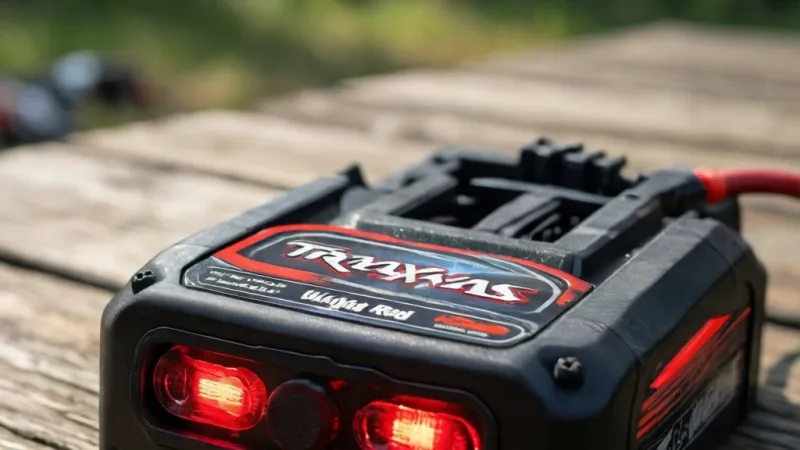
A blinking red light is your charger's way of saying, "I stopped on purpose." Every Traxxas EZ-Peak charger has built-in safety logic. When something falls outside safe charging parameters, the charger halts the cycle and flashes the LED instead of pushing current into a battery that could be damaged or dangerous.
That safety logic matters most with lithium packs. LiPo batteries can vent, swell, or catch fire if they're charged incorrectly. Per NFPA lithium battery safety guidance, a damaged or over-discharged lithium pack should never be forced onto a charger.
The blinking red light is the charger doing its job.
The tricky part is that the same visual signal covers several different problems. A low-voltage LiPo looks identical to a bad connection on the LED. So does a reverse-polarity hookup or an overheated pack.
Here's what the blinking red light is actually telling you, in plain terms:
- The charger detected an unsafe condition and paused or aborted the charge.
- The condition could be in the battery, the wiring, the power source, or the charger itself.
- You need to isolate which one before you try charging again.
The Three Fault Buckets
Almost every blinking-red scenario falls into one of these buckets:
- Battery fault. The pack is over-discharged, has an imbalanced cell, is too hot, too cold, or internally damaged.
- Connection fault. The Traxxas High-Current Connector or balance lead is dirty, loose, corroded, or wired backward.
- Charger fault. The unit overheated, saw a bad input voltage, has outdated firmware, or has an internal failure.
Finding the bucket is 90% of the fix. The rest is just running the checks in the right order.
Quick Answer
A blinking red light on a Traxxas battery charger means the charger found a fault. It has stopped charging for safety. Common causes include low battery voltage, bad connections, or the wrong battery type.
A damaged or swollen LiPo will also trigger it. Check the battery first, then the connectors. If those are fine, test another battery.
That tells you whether the charger or the pack is the problem.
First 5 Checks Before You Panic
Before you assume the worst, run these five checks in order. They take under ten minutes and catch the majority of blinking-red cases reported by owners.
Check 1: Disconnect and Let Everything Cool
Unplug the battery from the charger. Set both aside for 15 to 20 minutes. LiPo packs that just finished a hard run can hit 50°C (122°F) or higher.
Many Traxxas chargers refuse to start a cycle above a set internal temperature threshold.
If the pack is warm to the touch, that alone can trigger the blink. Let it cool to room temperature, then try again.
Check 2: Look at the Battery
Pick up the pack and inspect it. You're looking for:
- Swelling or puffing in the LiPo case. A puffy pack is done. Do not charge it.
- Punctures, dents, or crushed corners.
- Burn marks, melted shrink wrap, or a burnt smell.
- Loose or wiggling balance leads.
If you see any of these, stop. A swollen LiPo is a fire risk. Follow local lithium battery disposal rules and recycle it at a proper facility.
Check 3: Inspect the Connectors
Traxxas High-Current Connectors and iD plugs collect dirt and corrosion over time. Look inside the connector housing for:
- Dark or greenish residue on the metal contacts.
- Bent or pushed-in pins.
- A connector that doesn't click firmly into place.
- Frayed wires near the plug.
Clean contacts with isopropyl alcohol and a cotton swab. Let them dry fully. A weak connection causes voltage sag that the charger reads as an error.
Check 4: Verify the Power Source
If you're running on 12V DC from a car battery or power supply, check the voltage. Most EZ-Peak chargers need at least 11V to start a cycle. A sagging car battery or a weak power supply will trigger the blink.
On AC power, try a different outlet. Skip power strips and extension cords for this test. Plug directly into a wall socket.
Check 5: Try a Known Good Battery
This is the split test, and it's the fastest way to narrow the fault. Grab a second battery you know works and connect it to the same port. If it charges normally, your original pack is the problem.
If the charger blinks red with the second pack too, the fault sits in the charger or the power source.
That single test eliminates half the guesswork. We'll run the full version of it in a moment.
Know Your Charger: EZ-Peak Plus, Dual, Live, and ID Blink Patterns
Not every Traxxas charger speaks the same LED language. The blink pattern and what it means depend on the model. Here's how the main EZ-Peak family breaks down as of 2026.
| Charger Model | LED Behavior | Typical Meaning |
|---|---|---|
| EZ-Peak Plus (2970) | Red blinking | Charge error, bad battery, or connection fault |
| EZ-Peak Dual (2972) | Red blinking on one port | Fault isolated to that port or its battery |
| EZ-Peak Live (2971) | Red blinking plus app alert | Error code shown in Traxxas Link app |
| EZ-Peak ID (2973) | Red blinking, no green | iD battery not recognized or fault detected |
What Each Pattern Actually Tells You
On the EZ-Peak Plus, a red blink that never turns green usually means the charger detected a voltage or connection problem within the first few seconds. It never got far enough to start a real charge cycle.
On the EZ-Peak Dual, if only one port blinks red, you've narrowed it fast. Swap the battery to the other port. If the error follows the battery, it's the pack.
If it stays on the same port, it's the charger channel.
The EZ-Peak Live pushes more detail through the Traxxas Link app. You'll see an error code and often a plain-language message. That's the fastest diagnostic path if you own one.
iD vs Non-iD Batteries
Traxxas iD batteries carry a chip that auto-configures charge settings. If you're using a non-iD pack with an adapter, the charger can't read the battery type. That mismatch alone can trigger a red blink.
If you're using an adapter without a balance lead connected, the charger may refuse to start. Balance charging is mandatory on multi-cell LiPo packs, and the charger knows when the lead isn't there.
Is It the Battery or the Charger? The Split-Test Decision
This is where most people get stuck. The blinking red light looks the same whether the battery is dead or the charger is fried. Here's the if/then logic that sorts it out.
Step 1: Swap the Battery, Keep the Charger
Put a known good battery on the same port. If it charges normally, your original battery is the problem. Move to battery diagnosis.
If it also blinks red, go to step 2.
Step 2: Swap the Port or Charger
If you have a dual charger, move the same battery to the other port. If the second port charges fine, the first channel is faulty. If you only have one charger, borrow a friend's or use a second charger you trust.
Step 3: Measure the Battery Voltage
Grab a multimeter. Set it to DC volts. Touch the probes to the main connector, not the balance lead.
- LiPo 2S: nominal 7.4V, full 8.4V, danger below 6.0V.
- LiPo 3S: nominal 11.1V, full 12.6V, danger below 9.0V.
- LiPo 4S: nominal 14.8V, full 16.8V, danger below 12.0V.
- NiMH 6-cell: nominal 7.2V, full around 8.4V.
If a LiPo cell reads below 3.0V, the pack is over-discharged. Most smart chargers will refuse it. That's the blink.
Step 4: Check Cell Balance
Switch the multimeter to the balance lead pins. Measure each cell individually through the balance connector. If any cell is more than 0.1V off from its neighbors, the pack is imbalanced.
A severely imbalanced pack trips the red blink.
Step 5: Rule Out the Charger
If the battery checks out, the charger is suspect. Common charger-side causes include:
- Internal overheat from a long session or blocked vents.
- Firmware out of date. Check via the Traxxas Link app if your model supports it.
- A blown internal fuse after a short or reverse-polarity event.
- A failed channel on a dual charger.
Step 6: Read the Result and Act
If the fault follows the battery, retire the pack. If the fault stays with one port across multiple batteries, that channel has failed. If every battery blinks on every port, test a different power source before you blame the charger.
One last thing on safety. If a LiPo pack is swollen, hot, or smells sweet, get it outside and away from anything flammable. Don't charge it, don't store it indoors, and don't try to "wake it up" with a low-current trickle.
Damaged lithium cells don't heal, and the cost of a new pack is nothing next to a house fire.
LiPo vs NiMH: How Battery Chemistry Changes the Diagnosis
The chemistry inside your pack decides which faults are possible. A blinking red light on a NiMH pack points at a completely different list of causes than the same blink on a LiPo. Getting this wrong wastes time and can push you toward an unsafe fix.
Traxxas Power Cell batteries come in both NiMH and LiPo versions, and both work with the iD system. But they charge on very different logic.
How Each Chemistry Charges
NiMH packs charge on constant current. The charger watches for a small voltage drop near the end of the cycle, called delta peak. When it sees that drop, it stops.
LiPo packs charge in two stages. First constant current, then constant voltage. The charger also monitors every individual cell through the balance lead.
If one cell drifts, the cycle stops.
That difference explains most of what you're seeing. NiMH faults tend to be about heat and false peaks. LiPo faults tend to be about cell voltage and balance.
| Factor | NiMH | LiPo |
|---|---|---|
| Balance lead needed | No | Yes, mandatory |
| Nominal voltage per cell | 1.2V | 3.7V |
| Full charge per cell | About 1.45V | 4.2V |
| Storage voltage | Not critical | 3.8V per cell |
| Common blink trigger | Heat, false peak, low pack voltage | Cell imbalance, over-discharge, swelling |
| Fire risk if abused | Low | High |
Why NiMH Packs Trigger Red Blinks
NiMH cells are tougher, but they still trip chargers. A pack that's been sitting for six months often reads well below its nominal voltage. Some Traxxas chargers will refuse it and blink instead of starting a trickle.
Heat is the other big one. NiMH packs get noticeably warm near the end of a charge. If a pack is already warm from a run, the charger may read the temperature as a fault and stop.
False peaks happen too. A dirty connector causes voltage noise, and the charger reads that noise as the end-of-charge drop. It stops early, then blinks because the pack isn't actually full.
NiMH packs can also suffer reversed cells. If one cell in a 6-cell or 7-cell pack has been driven below zero volts, the whole pack reads wrong. That trips the blink every time.
Why LiPo Packs Trigger Red Blinks
LiPo packs are far less forgiving. Anything below 3.0V per cell is a red flag, and most chargers won't touch a pack in that state.
Cell imbalance is the most common LiPo trigger reported by owners. If one cell sits 0.1V or more away from its neighbors, the charger stops to protect the pack. That usually means the pack is aging, damaged, or has a failing cell.
Physical damage is the other big one. A LiPo that's been in a hard crash, run in the wet, or stored in a hot garage can develop internal resistance issues. The charger sees that as an unstable pack and refuses it.
Swollen LiPo packs are a hard stop. Don't charge them, don't store them indoors, and don't try to "recover" them. Take them to a lithium battery recycling point.
The Adapter Trap
Here's a mistake that catches a lot of people. You buy a cheap adapter to run a non-iD battery on an EZ-Peak charger. The main connector fits.
The balance lead doesn't get plugged in.
The charger reads the missing balance connection as a fault and blinks red. Nothing is wrong with the battery or the charger. The setup is incomplete.
If you're running a non-iD LiPo, you need both the main connector adapter and a balance board that matches the pack's cell count. Two wires, not one.
Low Voltage, Cell Imbalance, Heat, and Swelling Red Flags
Some faults are recoverable. Some aren't. Knowing the difference keeps your gear alive and your house intact.
Voltage Thresholds That Matter
Use a multimeter on the main connector to read total pack voltage. Then check each cell through the balance lead. Here's what the numbers mean.
| Pack Type | Healthy Range | Warning Zone | Do Not Charge |
|---|---|---|---|
| LiPo 2S | 7.4V to 8.4V | 6.6V to 7.4V | Below 6.0V |
| LiPo 3S | 11.1V to 12.6V | 9.9V to 11.1V | Below 9.0V |
| LiPo 4S | 14.8V to 16.8V | 13.2V to 14.8V | Below 12.0V |
| NiMH 6-cell | 7.2V to 8.4V | 6.0V to 7.2V | Below 5.0V |
| NiMH 7-cell | 8.4V to 9.8V | 7.0V to 8.4V | Below 6.0V |
A pack in the warning zone might still charge on a low current setting. A pack in the do-not-charge column is done. Most smart chargers won't even attempt it.
What Cell Imbalance Looks Like
Check each cell individually through the balance connector. On a healthy 3S pack, all three cells should read within 0.05V of each other. Anything over 0.1V is a problem.
A pack that reads 4.18V, 4.19V, and 3.90V is imbalanced. The charger sees that spread and stops. Balance charging can fix small gaps over time.
Large gaps usually mean a cell is failing.
Temperature Limits
Charging outside the safe temperature window triggers a blink on most Traxxas chargers. Here are the ranges that matter.
- LiPo charge range: 0°C to 45°C (32°F to 113°F).
- LiPo storage range: 5°C to 25°C (41°F to 77°F) is ideal.
- NiMH charge range: 0°C to 40°C (32°F to 104°F).
- Stop immediately if a pack exceeds 60°C (140°F) during charge.
Cold packs charge badly. A LiPo at 0°C will sag under load and can false-peak. Warm it to room temperature first.
Never use a heater or microwave to speed that up.
Swelling, Smell, and Other Physical Warnings
Put a suspect LiPo on a flat surface like a glass table. A healthy pack sits flat. A puffy pack rocks or shows a visible bulge.
Any bulge means retire it.
Smell matters too. A sweet, solvent-like odor near the pack means a cell has vented. Get it outside immediately and away from anything flammable.
Other red flags that mean stop:
- Melted or bubbled shrink wrap.
- Burn marks around the connector.
- A balance lead that's stiff, brittle, or frayed.
- Any pack that gets hot during storage with no load on it.
Voltage Recovery: When It's Worth Trying
For NiMH, a low pack can sometimes be recovered. A short trickle charge at 0.1A for 15 to 20 minutes can bring it back above the charger's threshold. Watch it the whole time.
For LiPo, recovery is a different story. Below 3.0V per cell, the pack is chemically compromised. Some experienced users try a 0.1A trickle on a bench supply to lift the voltage.
That's a fire risk and a judgment call we don't recommend.
If a LiPo has dropped below 2.5V per cell, it's finished. Recycle it.
Step-by-Step Troubleshooting Workflow
Here's the full sequence, in order, with time estimates. Work through it once and you'll usually land on the answer within 30 minutes.
| Step | What You're Doing | Time |
|---|---|---|
| 1 | Cool everything down | 15 to 20 min |
| 2 | Inspect battery, connectors, power source | 5 min |
| 3 | Split test with a known good battery or port | 5 min |
| 4 | Reset charger and check firmware | 10 min |
| 5 | Decide: fix, warranty, or replace | 5 min |
Step 1: Disconnect the Battery and Let Everything Cool
Unplug the battery from the charger first. Then unplug the charger from the wall or 12V source. Let both sit for at least 15 minutes in a normal room.
Don't skip this. A pack that's warm from a run will trigger a thermal fault on most EZ-Peak models. Waiting costs you nothing.
While you wait, look at the ambient temperature. A garage at 35°C (95°F) is too hot to charge safely. Move indoors to a climate-controlled space with good airflow.
Step 2: Inspect the Battery, Connectors, and Power Source
Start with the pack. Check for swelling, damage, and heat. Then move to the wiring.
Look inside the Traxxas High-Current Connector and the iD plug. Dark residue, green corrosion, or bent pins all cause voltage drops that the charger reads as faults. Clean contacts with isopropyl alcohol on a cotton swab, then let them dry fully.
Check the balance lead on LiPo packs. Wiggle each wire gently at the connector. If the voltage reading jumps, the lead is broken internally.
Now check the power source. On 12V DC, measure the input voltage at the charger's leads. Anything below 11V under load is a problem.
On AC, plug directly into a wall socket and skip power strips and extension cords.
Step 3: Test With a Known Good Battery or Charger Port
Take a battery you know charges fine and put it on the same port. Let it run for 60 seconds. If the good battery charges normally, the original pack is the problem.
If it also blinks, the fault is in the charger or the power source.
On a dual charger, swap the same battery to the other port. That tells you whether the issue is one channel or both.
Step 4: Reset the Charger and Check Firmware
Unplug the charger for a full 30 seconds. Plug it back in with no battery attached. Let it complete its startup sequence.
If it blinks red with nothing connected, the charger itself is faulty.
If your model supports the Traxxas Link app, open it and check the firmware version. Outdated firmware can cause false faults, especially on newer iD battery revisions. Update if an update is available.
On dual chargers, run the same reset test on each port separately. A single bad channel is a common failure point after a short circuit or reverse-polarity event.
Step 5: Decide Whether to Fix, Claim Warranty, or Replace
Use these rules to pick your next move.
- If the fault follows the battery, recycle the pack and buy a replacement. Don't try to save a swollen or over-discharged LiPo.
- If the fault follows the port or charger, and the unit is within its warranty window, contact Traxxas support before opening anything.
- If the charger is out of warranty, compare the cost of a replacement against a repair. On most EZ-Peak models, replacement is the cheaper path.
- If the fault is a dirty connector or a missing balance lead, fix it yourself and retest.
One hard rule: never open a charger that's still under warranty. That voids coverage. And never open any charger that's plugged in.
Mistakes That Make a Blinking Red Light Worse
Most of the damage we see reported isn't caused by the original fault. It's caused by what people do next. Here are the moves that turn a small problem into an expensive one.
Re-Plugging to Force a Charge
Repeatedly unplugging and reconnecting a pack does nothing good. The charger is detecting the same fault every time. You're just cycling heat through the connector contacts.
Charging a Swollen Pack Anyway
This is the one that starts fires. A puffy LiPo has already failed internally. Charging it adds energy to a compromised cell.
There's no safe way to do this.
Using the Wrong Mode
NiMH mode on a LiPo pack will overcharge it. LiPo mode on a NiMH pack will confuse the peak detection and stop early. Match the mode to the chemistry every single time.
Charging Off a Weak 12V Source
A car battery with the engine off, or a small power supply, will sag under charging load. The charger sees the voltage drop and faults out. Use a healthy supply or switch to AC.
Charging Above 1C
A 5,000mAh pack charged at 5A is a 1C rate. That's the standard. Pushing to 2C or higher on a regular basis heats the pack and shortens its life.
It also raises the odds of a thermal fault mid-cycle.
Leaving Packs Plugged In After the Charge Ends
A finished pack sitting on the charger can slowly self-discharge or trigger a maintenance cycle. Unplug it when the light goes green. Then store it at the right voltage.
Storing Packs at Full Charge
A LiPo stored at 4.2V per cell for months ages fast. Store at 3.8V per cell using the charger's storage mode. NiMH packs should be stored around half charge.
Ignoring Corrosion
Green residue on a connector looks harmless. It isn't. It adds resistance, which causes voltage sag, which causes false faults.
Clean connectors every few months.
Charging on Carpet or in a Closed Space
LiPo fires need airflow and a non-flammable surface. Charge on concrete, metal, or stone. Use a LiPo bag.
Never charge inside a closed car or on a carpeted floor.
Assuming a New Battery Can't Fault
Fresh packs fail too. A factory defect, shipping damage, or a bad weld on the balance lead will trip the blink on the very first cycle. Test a new pack the same way you'd test an old one.
When to Stop and Contact Traxxas Support
Some faults need a support ticket, not a workaround. Here's how to tell the difference and what to have ready when you reach out.
Signs the Charger Is the Problem
- The red blink happens with every battery you try, including known good ones.
- The charger blinks red with no battery attached.
- One port on a dual charger fails while the other works.
- You see or smell burning, or the case is hot to the touch with nothing connected.
- The unit has physical damage from a drop, a short, or a reverse-polarity hookup.
If any of these apply, stop testing. Unplug the charger and contact support.
Signs the Battery Is the Problem
- The blink only happens with one specific pack.
- The pack shows swelling, heat, or a sweet smell.
- A multimeter reads below the safe voltage thresholds covered earlier.
- One cell is more than 0.1V off from the others and won't recover with balance charging.
In these cases, the charger is doing its job. Recycle the pack.
What to Have Ready for Support
Traxxas support will ask for specific details. Have these in hand before you call or submit a ticket.
- Charger model number and serial number.
- Battery model, chemistry, and cell count.
- The exact blink pattern, including how many blinks and how fast.
- Purchase date and proof of purchase.
- A short video of the blink pattern with the battery connected.
- What you've already tried, in order.
The video matters more than people expect. Support staff can often identify the fault from the blink cadence alone. A 10-second clip saves a lot of back-and-forth.
You can start that process through Traxxas support using your model number and a description of the blink. Their documentation is the definitive source on what each LED sequence means for your specific charger.
Safety First, Always
If a pack is hot, smoking, or swelling, don't call support first. Get it outside and away from anything flammable. Put it on concrete or bare ground.
Then handle the paperwork.
A venting LiPo can reignite hours after it looks calm. Keep it isolated for at least 24 hours before you move it anywhere.
One last note on timing. If your charger is still under warranty, don't buy a replacement before you talk to support. Many blinking-red cases get resolved with a firmware update, a connector cleaning, or a warranty swap.
You'd be surprised how often the fix is free.
Safe Charging Habits for LiPo and NiMH Batteries
Most blinking-red events trace back to charging habits, not hardware. Fix the habits and you cut the fault rate dramatically. Here's what charger manuals and fire-safety guidance say to do every time.
Where to Charge
Charge on a non-flammable surface. Concrete, stone, ceramic tile, or a metal tray all work. Carpet, wood, paper, and fabric do not.
Keep the area ventilated. A garage with the door cracked open beats a sealed closet. Never charge inside a parked car, even with the windows down.
Keep a fire extinguisher rated for lithium fires nearby. A Class D extinguisher or a bucket of dry sand works. Water makes a lithium fire worse in some cases, so don't count on it.
The LiPo Bag Question
A LiPo safety bag is cheap insurance. It won't stop a full thermal runaway, but it contains most small vents and stops burning material from spreading.
Put the pack inside the bag while charging. Route the leads out through the opening. Seal the flap with the Velcro strip.
For larger packs, some users charge inside a steel ammo can with the lid resting on top. That works too. Just don't seal it airtight, because pressure needs somewhere to go if a cell vents.
Charge Rate Rules
The standard charge rate is 1C, which means 1 amp per 1,000mAh of capacity. A 5,000mAh pack charges at 5A. A 3,000mAh pack charges at 3A.
| Pack Capacity | 1C Charge Rate | Typical Charge Time |
|---|---|---|
| 3,000mAh | 3.0A | 45 to 60 min |
| 4,200mAh | 4.2A | 50 to 70 min |
| 5,000mAh | 5.0A | 55 to 75 min |
| 6,700mAh | 6.7A | 70 to 90 min |
| 7,600mAh | 7.6A | 80 to 100 min |
Some packs are rated for 2C or higher. That's fine occasionally, but heat builds faster and pack life shortens. Stick to 1C for daily use.
Never exceed the charger's wattage ceiling. A 100W charger running a 6S pack at 5A would need 126W. The charger caps the current and takes longer, or faults out.
Storage Voltage and Long-Term Care
LiPo packs want to sit at 3.8V per cell for storage. That's roughly 50% charge. Use the charger's storage mode to bring them there before you put them away.
A pack stored at full charge for months loses capacity and can puff. A pack stored empty can drop below the safe threshold and die.
NiMH packs are more forgiving. Store them around half charge and recharge them every couple of months. They self-discharge faster than LiPo, so they'll be flat if you leave them for a season.
Temperature Rules for Storage
Heat is the enemy of both chemistries. Store packs between 5°C and 25°C (41°F to 77°F) where you can.
A hot garage in summer will cook a LiPo over a season. A freezing shed in winter will drop the pack below its safe floor. Both shorten life and raise the odds of a fault next time you charge.
What to Do If a Pack Vents
Get it outside. That's the first move, and it's the only one that matters in the first ten seconds.
Set it on bare concrete, gravel, or dirt, away from anything flammable. Don't pick it up with bare hands if it's hot. Use tongs or heavy gloves.
Don't try to smother it with water. Let it burn out. A venting cell burns until the fuel inside is spent, usually a few minutes per cell.
Once it's cool, keep it isolated outdoors for 24 hours. Reignition happens. After that, take it to a lithium battery recycling point.
Don't put it in household trash.
NiMH Specifics
NiMH packs are safer, but they have their own rules. Don't discharge them below 1.0V per cell under load. Deep discharge causes cell reversal, which permanently damages the pack.
Let them cool before charging. A hot NiMH pack will false-peak, and the charger will stop early and blink. Give it 20 minutes.
NiMH packs also benefit from a full discharge and recharge every few months. That keeps the cells balanced and prevents the voltage depression that older packs develop.
Charger and Battery Specs That Matter for Diagnosis
Knowing your charger's limits tells you what it can and can't do. A lot of red-blink reports come from pushing a charger past its rated output.
EZ-Peak Model Specs
Here's how the current Traxxas lineup compares. Specs are drawn from manufacturer documentation as of 2026.
| Model | Charge Current | Wattage | Cell Support | Input |
|---|---|---|---|---|
| EZ-Peak Plus (2970) | Up to 4A | 40W | 2S to 3S LiPo, 6 to 7 cell NiMH | 100-240V AC |
| EZ-Peak Dual (2972) | Up to 4A per port | 40W per port | 2S to 3S LiPo, 6 to 7 cell NiMH | 100-240V AC |
| EZ-Peak Live (2971) | Up to 8A | 100W | 2S to 4S LiPo, 6 to 8 cell NiMH | 100-240V AC, 12V DC |
| EZ-Peak ID (2973) | Up to 4A | 40W | 2S to 3S LiPo, 6 to 7 cell NiMH | 100-240V AC |
What These Numbers Mean in Practice
Wattage is the real limit. A 40W charger can push about 5A into a 2S pack, but only about 2.7A into a 3S pack. The charger caps current automatically to stay inside its wattage budget.
If you're charging a large 4S pack on a 40W unit, expect a slow cycle. If the charger faults out instead, the pack may be too large for the unit's rated range.
Cell count support matters too. A 4S LiPo won't charge on an EZ-Peak Plus or ID. The charger will blink red because the pack voltage is outside its detection window.
That's a design limit, not a fault.
Battery Specs to Have on Hand
Before you diagnose anything, find these numbers on your pack's label.
- Capacity in mAh.
- Cell count, listed as 2S, 3S, or 4S for LiPo, or 6-cell and 7-cell for NiMH.
- C-rating, which is the discharge rate, not the charge rate.
- Voltage, listed as nominal and full charge.
- Connector type, either Traxxas High-Current or iD.
The C-rating confuses people. A 50C pack at 5,000mAh can discharge at 250A. It says nothing about how fast you should charge it.
Charge rate is separate and usually printed as a small number near the capacity.
Multimeter Specs for Diagnosis
A basic digital multimeter is the single most useful tool for this job. You don't need a lab-grade unit. A $25 to $40 meter with DC voltage accuracy of plus or minus 0.5% is plenty.
Look for these features:
- DC voltage range down to 0.1V resolution.
- Continuity beeper for checking broken leads.
- Auto-ranging, which saves time on multi-cell packs.
- A 10A DC current range if you want to check charger output.
Skip the cheapest meters. A unit that reads 0.3V off will send you chasing the wrong fault.
Connector Types and Adapters
Traxxas uses two main connector systems. The Traxxas High-Current Connector is the older standard, found on most Power Cell packs. The iD connector adds a data pin that lets the charger read the battery automatically.
Adapters exist for both directions. A Traxxas-to-Deans or Traxxas-to-XT60 adapter lets you run aftermarket packs. But you still need a balance lead connection for any multi-cell LiPo.
If you're using an adapter with no balance board, expect a red blink. That's the charger refusing to charge blind.
Internal Resistance and Aging
Internal resistance climbs as a pack ages. A new 5,000mAh LiPo might read 3 to 5 milliohms per cell. After 200 cycles, that can double.
Higher resistance means more heat during charge and more voltage sag under load. When a pack's resistance climbs past roughly 10 milliohms per cell, it's near the end of its useful life. The charger may start faulting out as a result.
Most EZ-Peak chargers don't display resistance directly. The Traxxas Link app shows it on supported models. If your pack gets hot early in the charge cycle, resistance is the likely cause.
Traxxas Charger Blinking Red FAQs
What does a blinking red light on a Traxxas charger actually mean?
It means the charger detected a fault and stopped the cycle for safety. The cause is usually a battery voltage problem, a bad connection, an overheated pack, or a charger issue. It's a protective signal, not a random glitch.
Check the battery first, then the connectors.
Why does my Traxxas charger blink red with a fully charged battery?
A fully charged pack can still trigger the blink. If the voltage reads above the charger's expected window, it refuses the cycle. This happens with packs charged on another charger or left on a maintenance cycle.
Discharge the pack to storage voltage, then retry.
Can I charge a LiPo battery if the charger keeps blinking red?
No. If the charger blinks red on a LiPo, it detected something unsafe. Forcing a charge risks a fire.
Check the cell voltages first. Anything below 3.0V per cell, any swelling, or any cell imbalance over 0.1V means the pack should be recycled.
How do I reset a Traxxas EZ-Peak charger?
Unplug the charger from its power source for a full 30 seconds. Plug it back in with no battery connected and let the startup sequence finish. If it still blinks red with nothing attached, the charger itself has a fault.
Contact Traxxas support before doing anything else.
Why does my Traxxas charger blink red on only one port?
One bad port on a dual charger points to a channel fault. Swap the same battery to the other port. If the second port charges normally, the first channel has failed.
That's usually an internal issue and a warranty matter rather than a user fix.
How long should a Traxxas battery take to charge?
At a 1C rate, most packs finish in 45 to 90 minutes. A 5,000mAh pack on a 40W charger takes longer because the wattage caps the current. If a charge runs past two hours, the charger has likely faulted and you're seeing a blink instead of a cycle.
Final Decision Guide: Battery, Charger, or User Error?
You've run the checks. Now you need a single answer. Use this table to land on it fast.
| What You Found | Diagnosis | What to Do |
|---|---|---|
| Good battery charges fine on the same port | Battery fault | Recycle the pack, replace it |
| Fault follows the battery across ports | Battery fault | Recycle the pack |
| Fault stays on one port with any battery | Charger channel fault | Contact Traxxas support |
| Charger blinks red with no battery attached | Charger fault | Unplug it, contact support |
| Voltage below safe threshold on a LiPo | Over-discharged pack | Recycle, do not attempt recovery |
| Cell imbalance over 0.1V that won't recover | Damaged pack | Recycle |
| Swelling, heat, or sweet smell | Failed cell | Get it outside, recycle it |
| Dirty or corroded connectors | User error | Clean contacts, retest |
| Missing balance lead on a LiPo adapter | User error | Add a balance board, retest |
| Weak 12V input under load | User error | Switch to AC or a stronger supply |
| Wrong battery mode selected | User error | Match mode to chemistry, retest |
| Charger hot with vents blocked | User error | Let it cool, clear the vents |
The 60-Second Version
If you only remember one thing, remember this order. Cool everything down. Inspect the battery.
Test a known good pack. Swap the port. Then decide.
Most blinking-red cases end at step two or three. Dirty connectors, a missing balance lead, or a pack that's simply worn out covers the majority of what owners report.
When the Answer Is "Replace It"
Batteries are consumables. A LiPo that's been through 150 to 250 charge cycles is near the end of its life. If it's puffing, running hot, or faulting on every charger you own, it's done.
Don't spend an hour trying to revive a pack that costs less than a tank of fuel. Recycle it properly and buy a fresh one. Your charger will thank you, and so will your peace of mind.
When the Answer Is "Call Support"
Chargers are a different story. A faulty EZ-Peak unit under warranty gets replaced or repaired at no cost. Don't buy a new one before you make that call.
Have your model number, serial number, purchase date, and a short video of the blink pattern ready. That combination gets most warranty claims resolved in a single conversation.
When the Answer Is "It's Me"
Plenty of red blinks are self-inflicted. Wrong mode, missing balance lead, weak power source, charging a hot pack, or pushing a 4S battery onto a 3S charger. None of those are hardware failures.
Read the charger's label and your pack's label once. Match the chemistry, the cell count, and the current. Then charge on a hard surface, in the open, with the pack in a bag.
That routine prevents most of what brings people searching for answers in the first place.